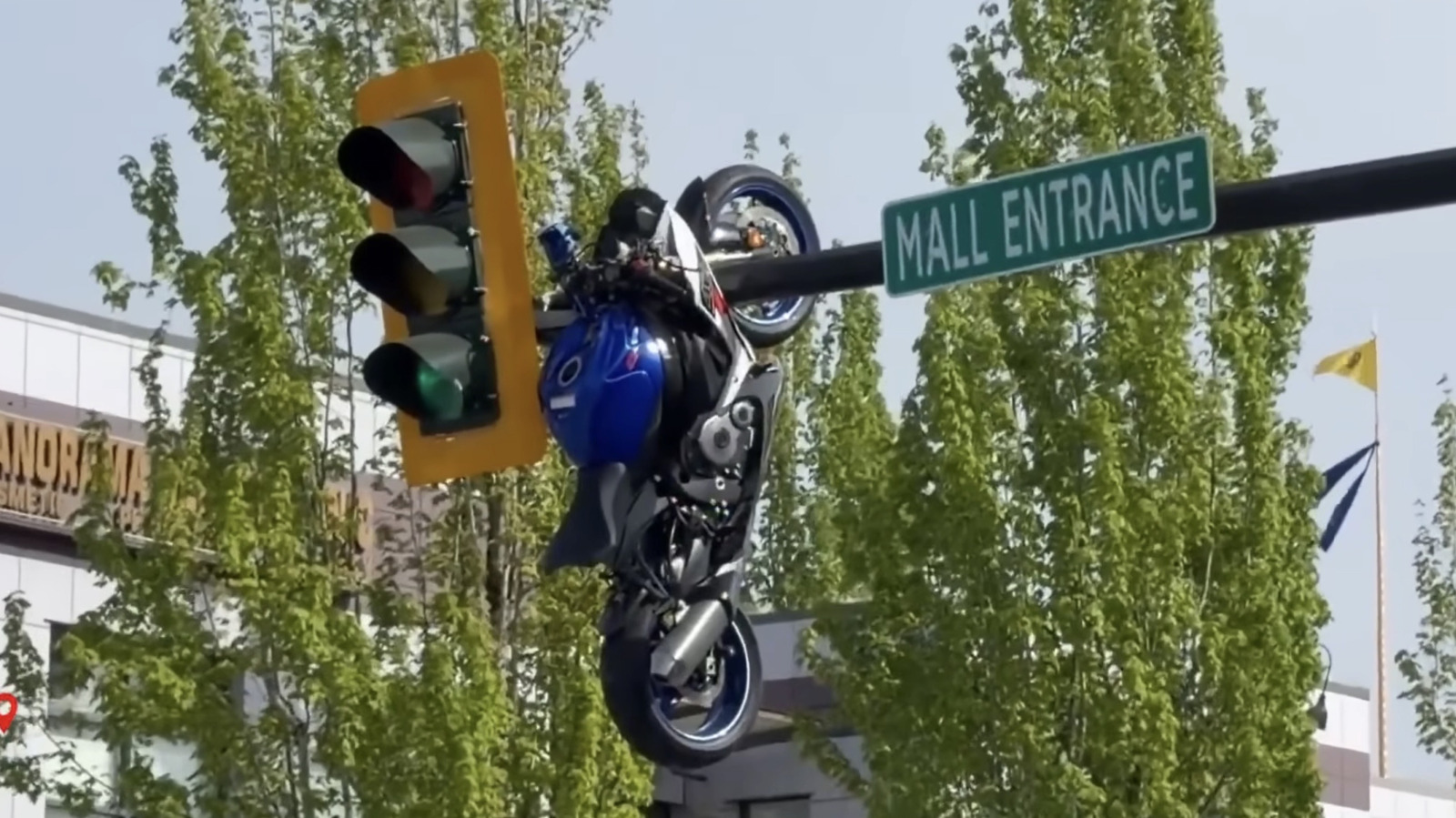
A motorcycle launched onto a street sign after a crash, leaving authorities with an unexpected recovery challenge. The bike impacted the pole with enough force to lodge itself in an awkward position, requiring specialized equipment and careful planning to extract the vehicle safely.
The incident highlights a hazard often overlooked in traffic safety discussions. When vehicles collide at certain angles and speeds, they don't always end up on the roadway where removal crews expect them. Instead, motorcycles and lighter vehicles can become airborne and lodge in overhead infrastructure like street signs, traffic signals, and utility lines.
Recovery operations for vehicles stuck at height demand more than standard towing. Emergency responders typically call for bucket trucks, cranes, or specialized rigging equipment to stabilize and lower the motorcycle without causing additional damage to the pole or nearby infrastructure. The process ties up traffic, blocks intersections, and requires coordination between multiple agencies.
Motorcycle crashes carry inherent risks that car accidents don't. Riders lack the protective cage that surrounds four-wheel vehicle occupants. Impact speeds that would leave a car's passengers with minor injuries often prove fatal or catastrophic for motorcycle riders. When a bike becomes airborne after a crash, the operator has already experienced significant trauma before the vehicle ever reaches the sign.
The specific details of how this motorcycle ended up suspended remain unclear, but the recovery operation itself serves as a reminder of secondary hazards created by traffic collisions. What begins as a single-vehicle incident cascades into a hours-long street closure, crane deployment, and emergency coordination.
For riders, crash prevention remains the only reliable mitigation strategy. Defensive riding techniques, proper gear, and awareness of road conditions and traffic patterns reduce the likelihood of the circumstances that lead to these spectacular but dangerous situations.