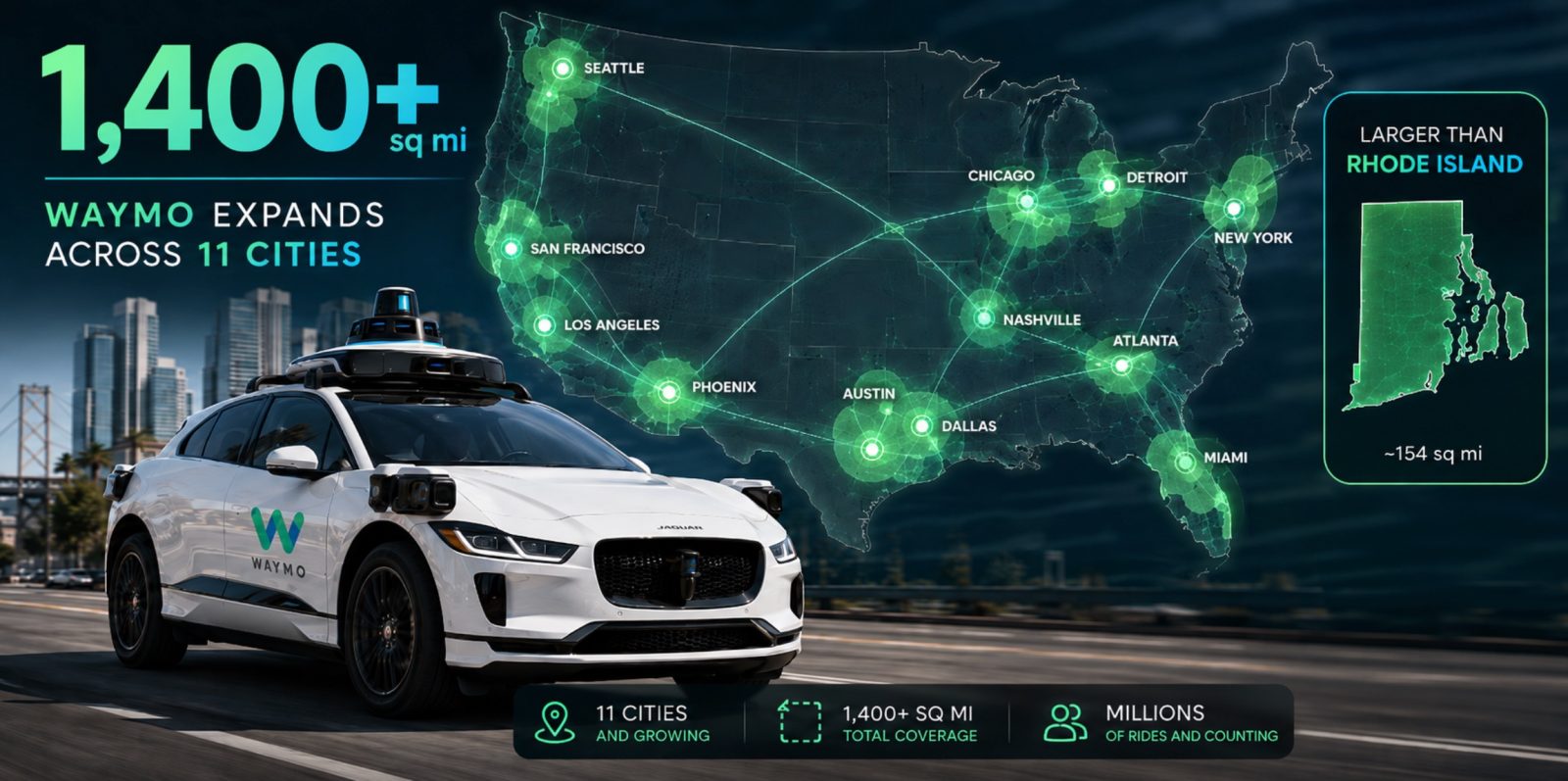
Waymo has expanded its robotaxi service footprint to over 1,400 square miles across 11 US cities, marking a 27% jump in coverage. The expansion exceeds Rhode Island's total land area and represents the autonomous vehicle company's most aggressive geographic push yet.
The rollout begins in Miami, followed by broader service launches in Austin, Atlanta, Houston, and the San Francisco Bay Area. This multi-city strategy signals Waymo's confidence in scaling operations beyond its established California strongholds.
The expansion matters for several reasons. First, it demonstrates Waymo's ability to deploy robotaxis faster than competitors. General Motors' Cruise remains sidelined after safety setbacks last year, while Tesla's Full Self-Driving faces regulatory scrutiny. Waymo's deliberate but steady approach has earned government trust in multiple jurisdictions.
Second, geography expansion directly impacts unit economics. More service areas mean higher ride volumes, better fleet utilization, and clearer paths to profitability. Waymo currently operates in San Francisco, Los Angeles, and Phoenix as core markets. Adding major metros like Miami and Austin provides access to millions of potential riders in car-dependent regions.
Third, this move challenges the traditional rideshare model. Uber and Lyft depend on human drivers and take 20-30% commissions. Waymo's driverless operations eliminate per-ride driver costs, theoretically allowing lower fares or higher margins. Scale becomes the deciding factor.
The expansion does face headwinds. Miami's challenging weather and unfamiliar road conditions test autonomous systems. Austin's rapid growth strains infrastructure. Houston's sprawl demands efficient routing. Atlanta's mixed traffic flows require robust perception systems.
Waymo's hardware, the custom-built Jaguar I-PACE based robotaxi with multiple sensors and lidar systems, handles these scenarios well in testing