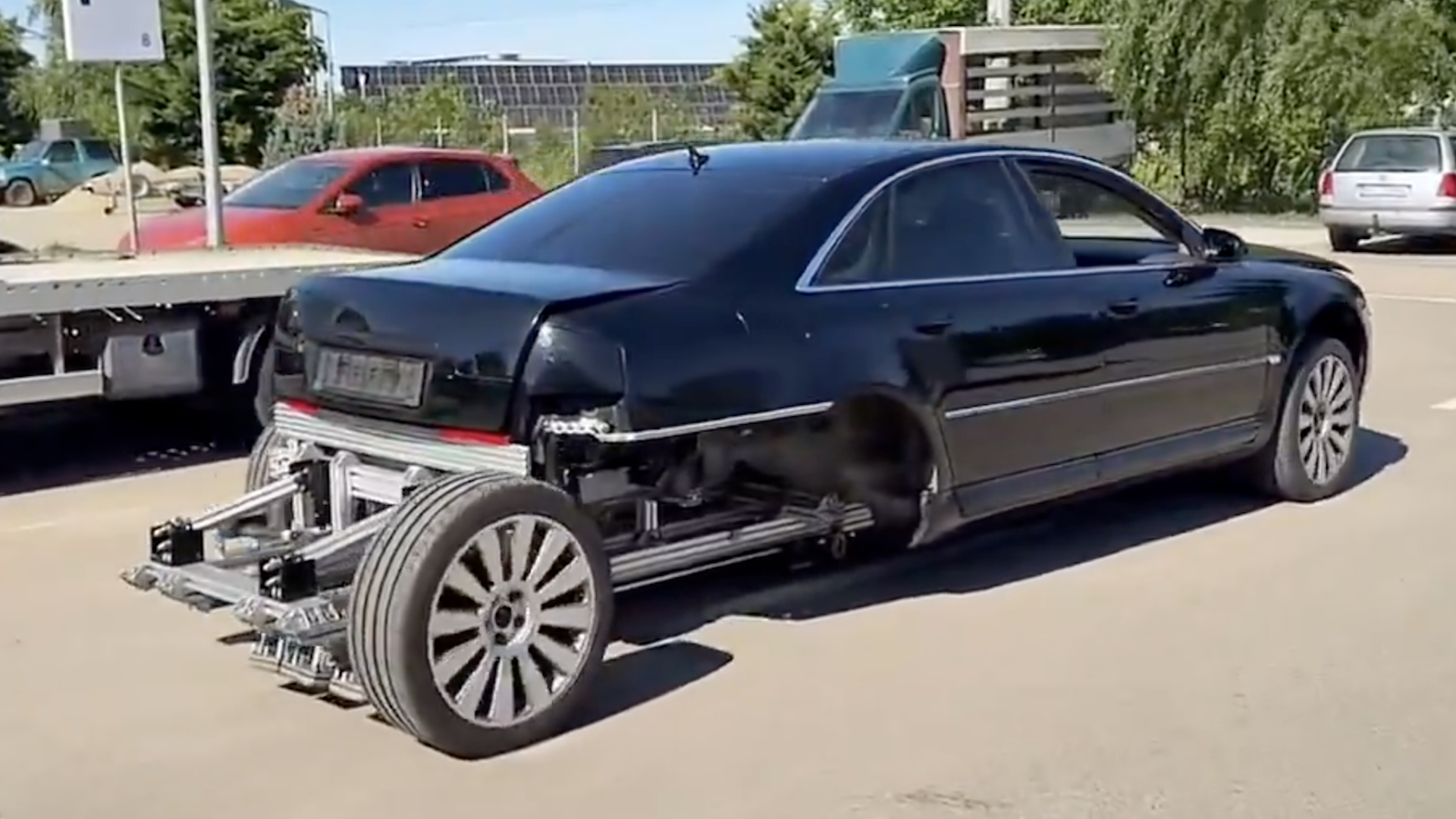
An Audi powered entirely by compressed air demonstrates jerky, unstable movement that looks nothing like conventional vehicle operation. The rear wheels slide back and forth unpredictably as the pneumatic system struggles to maintain smooth power delivery, creating a motion that resembles zombie-like lurching rather than normal automotive locomotion.
Compressed air propulsion represents an unconventional engineering experiment. Unlike electric motors or internal combustion engines, pneumatic systems release pressurized air through valves and actuators, translating that energy into mechanical movement. The challenge lies in consistency. Compressed air loses pressure as it expands, creating uneven force delivery to the wheels. This explains the unsettling rear-wheel behavior captured in footage of this Audi prototype.
Such projects typically emerge from research institutions, automotive enthusiasts, or experimental labs exploring alternative powertrains. Compressed air engines enjoyed brief academic and hobbyist interest decades ago, championed by engineers seeking zero-emission solutions. Companies like Tata Motors and MDI even developed compressed air car concepts in the early 2000s, though none reached production. The technology never scaled because it suffers from poor energy density, limited range, and the exact control problems on display here.
Modern automotive development has largely abandoned pneumatic propulsion in favor of battery electric vehicles, which offer superior efficiency, reliability, and driver experience. Tesla, BMW, and traditional manufacturers now focus engineering resources on lithium-ion chemistry and software optimization rather than air-based systems.
This Audi's jerky performance highlights why compressed air failed commercially. Drivers demand smooth acceleration and predictable handling. The rear-wheel sliding visible in this footage would translate to dangerous instability on roads, failed efficiency targets, and customer frustration. Modern electric drivetrains solved these problems through precise electronic control systems that modulate power instantly.
Compressed air vehicles remain curious engineering footnotes. They serve educational purposes