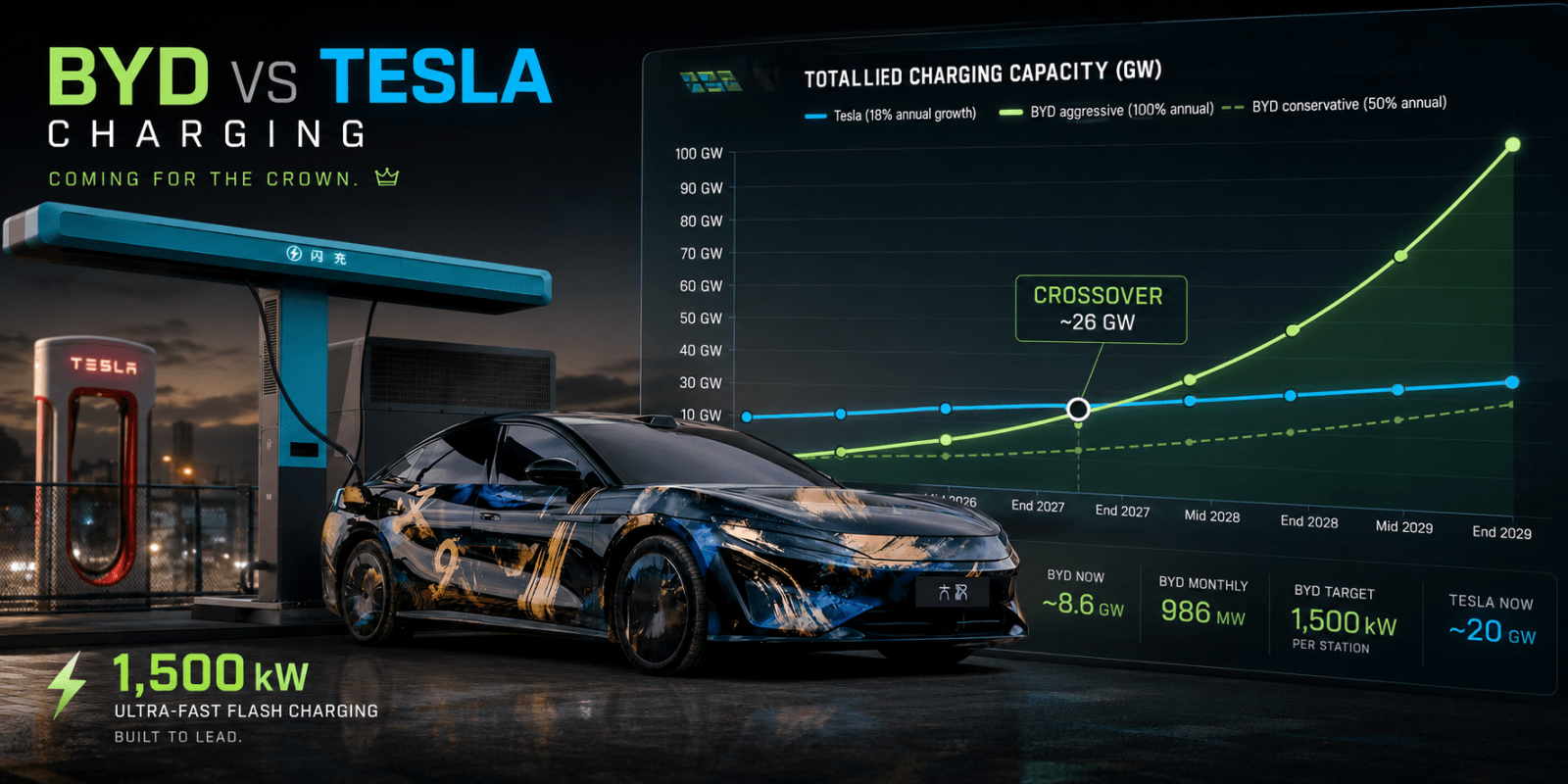
BYD has built a charging infrastructure juggernaut that dwarfs Tesla's current deployment pace. The Chinese automaker deploys 2.4 times more charging power monthly than Tesla, a gap that positions BYD to overtake Tesla's global Supercharger network within two to three years.
BYD's Flash Charging stations already number over 5,700 across China after just months of rollout. These chargers pump out 1,500 kW of power, triple the output of Tesla's latest V4 Superchargers. The company has moved beyond its home market, opening its first European stations and signaling aggressive international expansion.
The competitive dynamics here are stark. Tesla built the Supercharger network first and leveraged it as a selling point for years. That advantage is evaporating. BYD's manufacturing scale and home market dominance allow it to fund massive infrastructure buildouts while Tesla focuses capital elsewhere. Tesla's network, while extensive, has faced criticism for congestion and aging hardware in some regions. BYD's newer stations offer faster charging speeds and represent a generational leap in capability.
For EV buyers, this shift matters immediately. More charging stations with higher power delivery means less time tethered to a plug. BYD's push into Europe signals that Chinese charging standards and infrastructure are going global. European and North American drivers will increasingly see non-Tesla chargers that outperform legacy Superchargers.
The timing amplifies BYD's advantage. As EV adoption accelerates in Europe and beyond, having a charging network already installed and expanding fast gives BYD's vehicles a tangible advantage over competitors relying on third-party networks. Tesla can upgrade existing Superchargers, but retrofitting an aging network takes time and money. BYD builds new infrastructure from scratch, embedding superiority into its foundation.
This charging