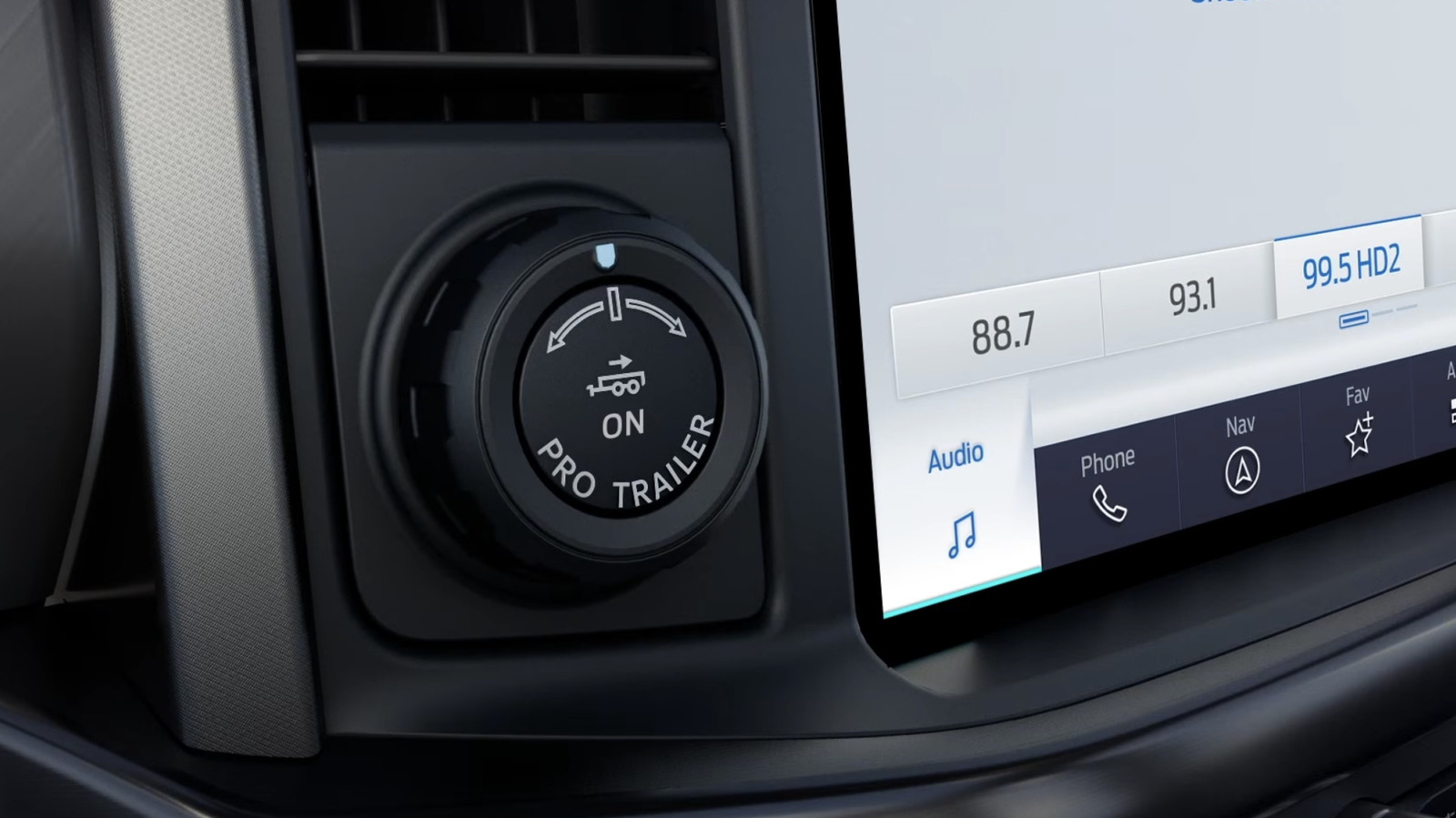
Ford's Pro Trailer Backup Assist uses cameras, sensors, and onboard computing to let drivers reverse trailers by rotating the right-hand dial on the steering wheel instead of turning the wheel itself. The system eliminates the counterintuitive steering inputs required in traditional trailer backing, where drivers must turn the wheel opposite to the desired trailer direction.
The technology pairs multiple camera feeds with ultrasonic sensors positioned around the truck bed. These sensors monitor the trailer's position and angle in real time. Ford's software processes this data and calculates the precise steering angle needed to move the trailer in the direction the driver wants, then automatically applies that steering input through the truck's power steering system.
Drivers control direction using the rotary dial on the steering wheel. Clockwise rotation angles the trailer right, counterclockwise angles it left. This intuitive input method matches how people naturally think about trailer direction, removing the mental gymnastics of conventional reversing. The system also lets drivers adjust speed independently, maintaining low velocity while concentrating on trailer positioning.
Ford introduced this feature on F-Series trucks starting with the 2021 generation. The system works up to speeds of 1 mph and handles trailers up to 14,000 pounds. It operates in parking situations but not highway speeds, keeping it focused on the specific challenge of tight-space maneuvering.
The real value emerges in tight quarters. Parallel parking a trailer, backing into a narrow campsite, or positioning a boat trailer for launch becomes substantially simpler. Professional drivers and fleet operators particularly benefit, as the system reduces backing-related damage and accidents that cost companies thousands annually.
Ford pairs this with other truck-bed technologies including its 360-degree camera system and blind-spot monitoring. Together, these features represent the automaker's push toward autonomous capability in work environments where precision matters most.
This isn't fully autonomous driving. Humans