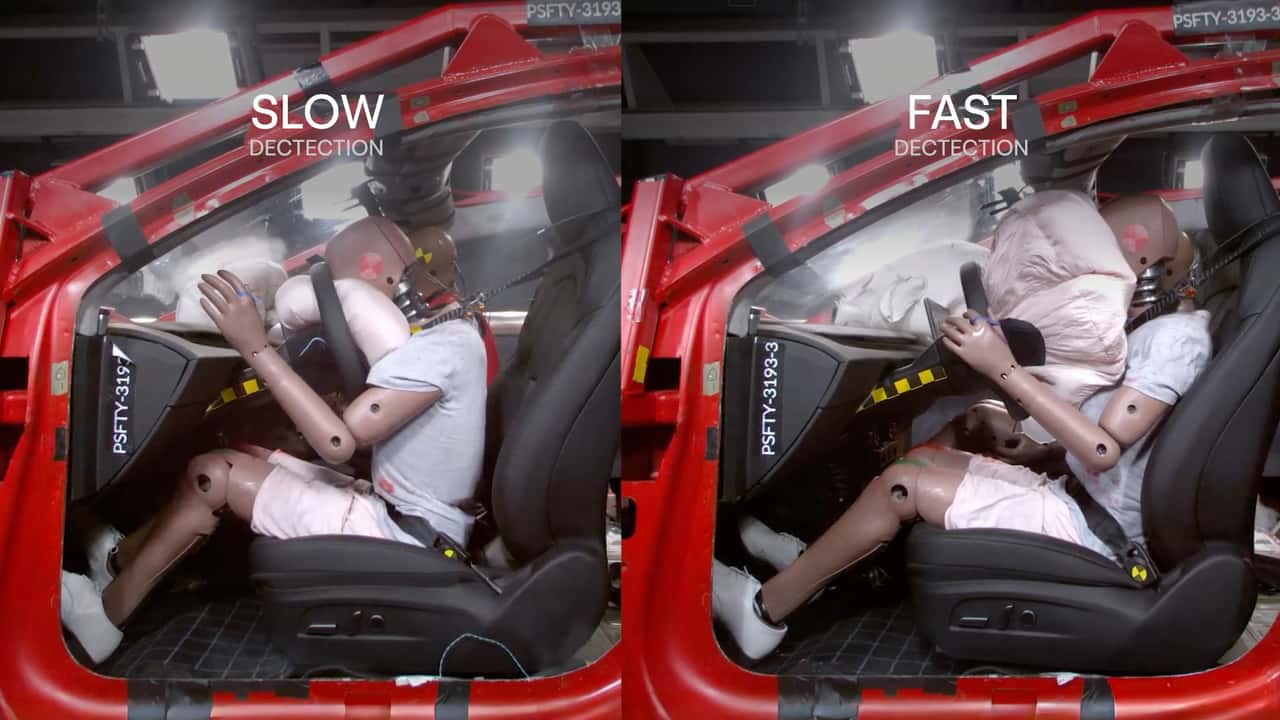
Tesla's latest safety technology deploys airbags before impact occurs, using the company's extensive camera network to predict collisions. The system detects crash scenarios milliseconds earlier than traditional impact sensors alone, allowing restraints to activate and protect occupants during the critical moments before contact.
The cameras feed data into Tesla's neural network, which identifies imminent collision patterns. When the system determines a crash is unavoidable, it triggers airbag deployment preemptively. This approach aims to position airbags optimally before impact, potentially reducing injury severity compared to reactive systems that fire only after the vehicle touches another object or obstacle.
Tesla's camera-based prediction system represents a shift in safety philosophy. Conventional airbag systems rely on accelerometers and impact sensors mounted in the vehicle's frame. These sensors measure deceleration forces after collision begins. Tesla's approach uses machine vision to recognize crash scenarios unfolding in real time, then acts before physics delivers impact forces to the vehicle structure.
The technology leverages data from Tesla's Autopilot and full self-driving suite, which depend entirely on camera inputs. The same vision system that processes road conditions for driving assistance now serves a protective function. Tesla collects vast amounts of driving data, training algorithms to recognize situations that precede accidents. Pedestrian detection, obstacle identification, and trajectory analysis inform the prediction model.
Pre-collision airbag deployment addresses a genuine safety window. A millisecond advantage translates to meaningful differences in occupant positioning when restraints engage. Properly deployed airbags reduce contact velocity with the vehicle's interior, lowering injury risk in moderate-to-severe crashes.
This development reflects Tesla's camera-centric design philosophy. While competitors incorporate lidar and radar for autonomous driving, Tesla relies exclusively on camera data. That choice now extends to active safety systems. The strategy bets on software advancement and neural networks outperforming hardware