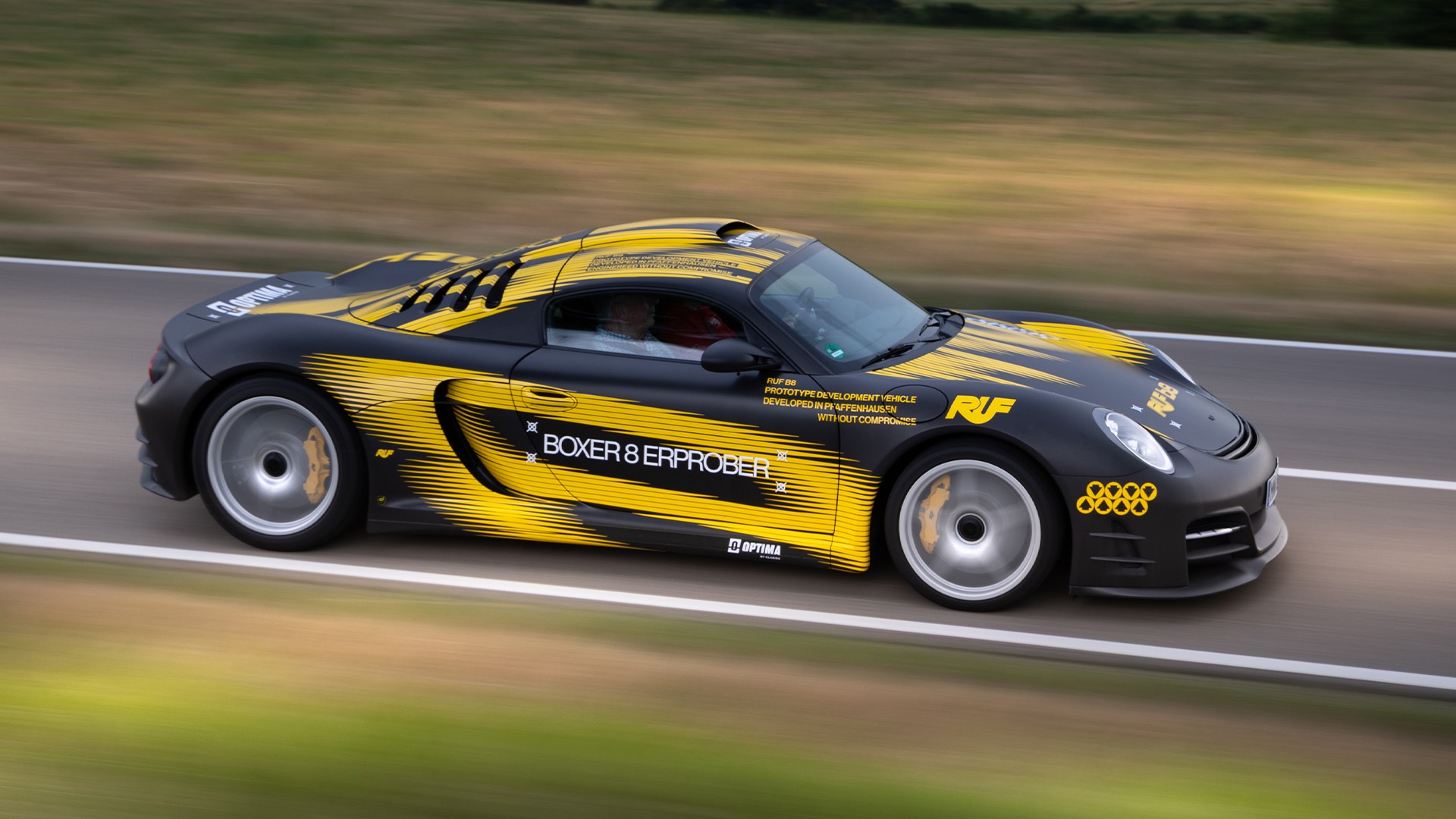
Ruf, the legendary Porsche tuner, has engineered a bespoke flat-eight engine producing over 1,000 horsepower. The 4.8-liter twin-turbocharged unit represents a complete ground-up design, not a modification of existing architecture. Currently, Ruf has installed the engine in a stretched CTR3 prototype for development and validation.
The flat-eight configuration itself marks a return to an engine layout Ruf explored decades ago but largely abandoned. Modern turbocharging, variable valve timing, and fuel injection allowed the company to resurrect the concept with cleaner emissions and reliable output. The 1,000-plus horsepower figure positions this powerplant well above Porsche's current 911 Turbo S, which produces 640 horsepower.
Ruf plans to integrate this engine into a production car, though the company has not disclosed a timeline or specific model. The CTR3 prototype serves as a testbed to validate durability, cooling, and drivability across real-world conditions. Such prototyping is standard practice for handbuilt performance engineers, where small production runs justify extensive bespoke development.
The flat-eight's return reflects broader trends in high-performance automotive engineering. As electrification dominates mainstream segments, independent manufacturers and small-volume specialists double down on internal combustion. Ruf's approach differs sharply from Porsche's 911 electrification strategy, positioning the tuner as a purist alternative for drivers who prioritize engine character and mechanical simplicity.
Power delivery from a naturally aspirated flat-eight differs fundamentally from turbocharged engines due to its inherent balance and firing order. Twin turbochargers mitigate the traditional lag associated with forced induction, while the flat-eight's low center of gravity and compact footprint offer