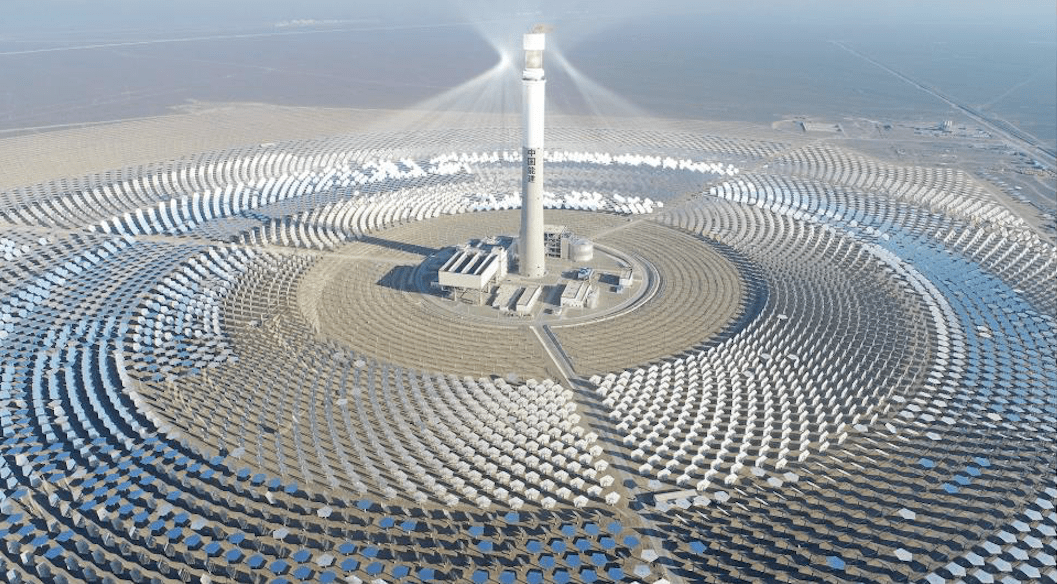
China Three Gorges Corporation has launched the world's largest hybrid solar facility in Xinjiang's Gobi Desert, combining photovoltaic panels with concentrated solar thermal technology. The 1-gigawatt Hami project stores heat in molten salt rather than relying on lithium batteries for nighttime power generation.
The facility operates on a straightforward principle. Concentrated solar collectors focus sunlight to heat molten salt to extremely high temperatures. This thermal energy stores in insulated tanks and feeds into conventional turbines for electricity generation. The system extends generation windows by eight hours after sunset, solving a persistent challenge in solar deployment. Nighttime production capability removes a major constraint on solar adoption in regions with limited battery infrastructure or where battery costs remain prohibitive.
The engineering shift matters for global renewable strategy. While lithium battery prices have dropped substantially over recent years, molten salt thermal storage offers different economics at utility scale. Salt-based systems handle repeated daily cycles effectively and avoid the supply chain dependencies tied to battery-grade lithium, cobalt, and nickel sourcing. China controls significant thermal salt technology expertise through decades of concentrated solar power research.
The Hami project represents a statement in the broader competition between energy storage technologies. Battery advocates point to falling costs and improving cycle life. Thermal salt proponents emphasize durability, scalability at massive capacity, and reduced reliance on imported materials. Both technologies coexist in reality. Battery systems excel at rapid response and grid stabilization. Thermal systems provide long-duration discharge suitable for overnight power delivery.
CTG's project arrives as China expands renewable capacity targets and reduces grid strain from coal dependency. Xinjiang's vast open land and high solar irradiance make it ideal for large-scale thermal projects. The facility demonstrates commercial viability for an approach largely abandoned in Western markets, where battery prices collapsed faster than thermal system costs declined.
For automakers and