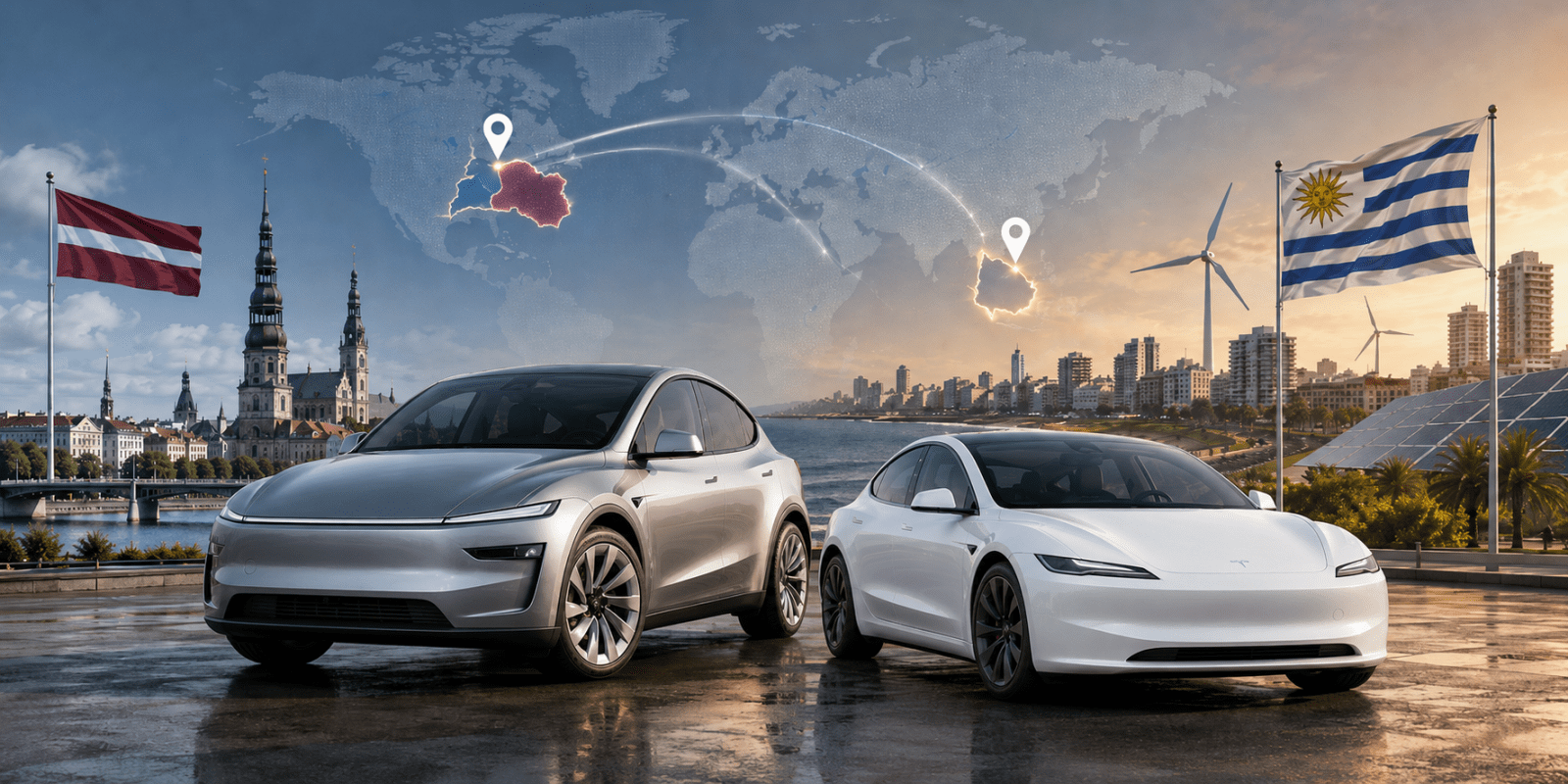
Tesla expanded into two new markets this week, launching operations in Latvia and Uruguay within 24 hours. The Latvia entry completes Tesla's coverage of all three Baltic states, following earlier launches in Lithuania and Estonia. Uruguay marks Tesla's third South American market, joining Argentina and Chile.
The dual expansion underscores Tesla's aggressive geographic strategy. The company targets markets across different continents and economic tiers, from developed European nations to emerging Latin American economies. Latvia offers access to a wealthy EU member state with strong EV adoption trends across Northern Europe. Uruguay represents a foothold in the Southern Cone region, where Tesla can service customers across the broader South American market through its existing Chilean and Argentine operations.
These entries follow Tesla's pattern of rapid market penetration. The company prioritizes establishing service networks and delivery infrastructure in new territories to support its growing vehicle sales. Both markets present distinct advantages. Latvia sits within the EU regulatory framework and benefits from European charging infrastructure development. Uruguay, conversely, offers growth potential in a relatively affluent South American nation with developing EV infrastructure.
Tesla faces different competitive landscapes in each region. In Latvia, European automakers like Volkswagen and BMW dominate, but EV adoption accelerates across the Baltic region. In Uruguay, competition remains limited from legacy automakers, giving Tesla early-mover advantage as the country transitions toward electrification.
The simultaneous launches reflect Tesla's resource capacity and confidence in scaling operations globally. Rather than sequentially entering markets, the company executes rapid, parallel expansions to capture market share before traditional competitors establish strong EV offerings. This approach maximizes brand presence and builds network effects through Supercharger infrastructure and service ecosystems.
Both markets represent long-tail growth opportunities. Individual volumes may remain modest compared to the US or China, but collectively, these expansions consolidate Tesla's position as the dominant global EV manufacturer. The strategy also hedges geographic and regulatory risk by