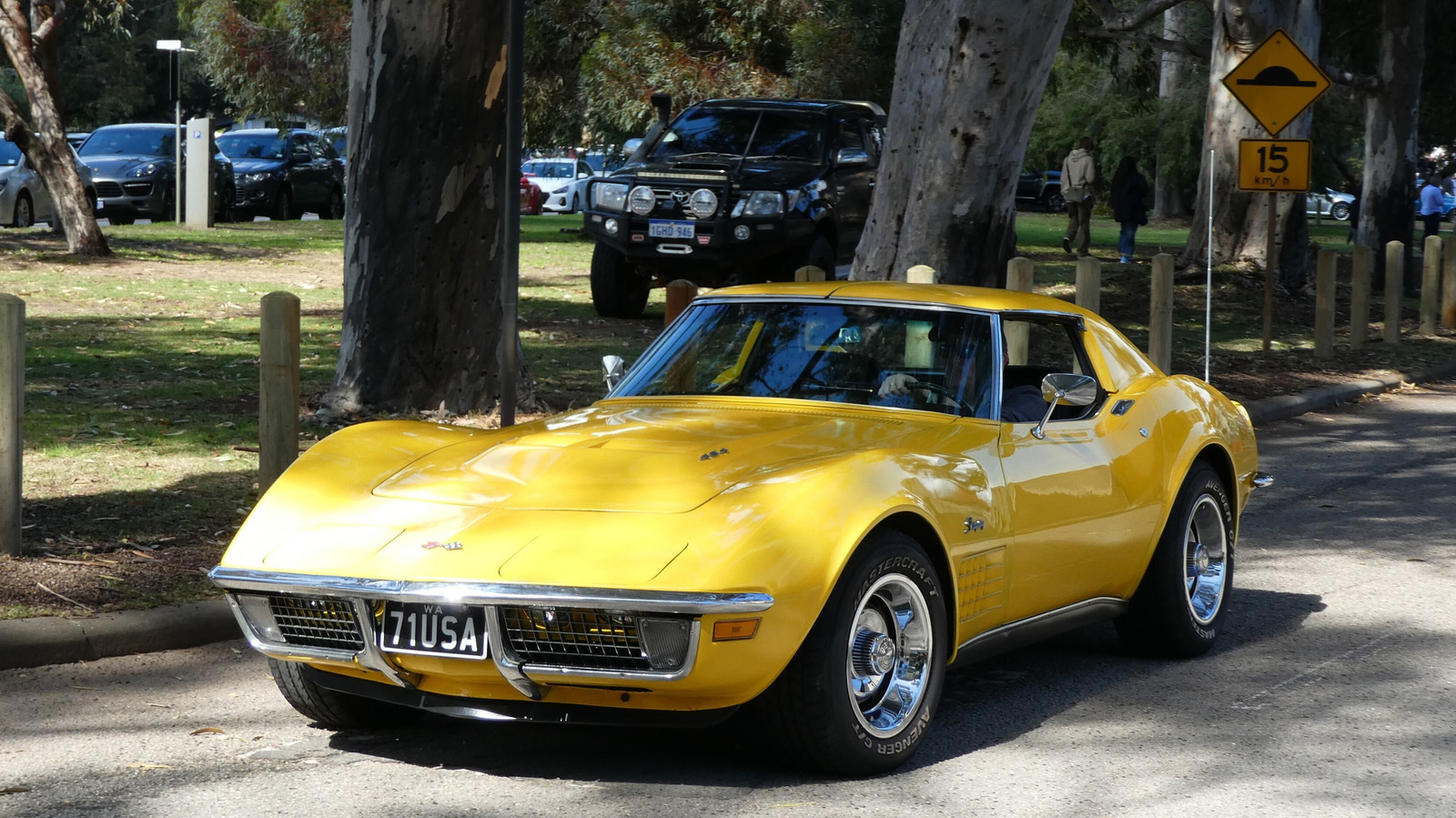
# Chevrolet Corvette Pricing Through the 1970s Reveals Muscle Car's Decline
The 1970s marked a turning point for the Chevrolet Corvette. What began as America's most celebrated sports car faced headwinds from emissions regulations, fuel economy mandates, and shifting consumer priorities. Pricing data from the decade tells the story of a nameplate trying to hold its ground during an era that fundamentally reshaped the American automotive landscape.
At the start of the 1970s, the Corvette carried serious muscle. The 1970 model year began with base prices around $5,192 for the coupe and $4,849 for the convertible. For context, that represented roughly $35,000 to $33,000 in today's money. Buyers received a 350-cubic-inch V8 engine producing 300 horsepower as standard equipment. That wasn't top-tier performance by pure numbers, but the Corvette remained one of the few attainable American performance cars targeting the middle class.
By 1973, however, everything changed. The Arab oil embargo crushed fuel-hungry performance cars. The base coupe price climbed to $5,398, but horsepower collapsed. That year's Corvette delivered just 250 horses from its 350-cubic-inch engine. Convertible production dropped sharply as consumer interest dried up. Chevrolet sold only 30,284 Corvettes in 1973, down from 54,966 just three years earlier.
The mid-to-late 1970s saw continued price escalation paired with declining performance. A 1975 Corvette coupe started at $6,810, representing a 31 percent increase from 1970. Horsepower remained stuck in the 165 to 205 range depending on the year and engine option. The 1976 model brought a 25th anniversary edition, yet even this special variant couldn't escape the decade's malaise. Engine sizes shrunk. Emissions equipment bloated. Performance enthusiasts increasingly looked toward imported sports cars like the Datsun 280Z or Porsche 911 for thrills.
Interestingly, Corvette prices didn't track with broader inflation perfectly. In 1979, the final year of the C3 generation's first stage, a base coupe cost $10,220. That represented a 96 percent increase from 1970, far outpacing typical inflation. Yet buyers received roughly one-third the horsepower. The value proposition collapsed entirely for performance-minded customers.
The 1970s Corvette crisis reflected larger industry trends. Manufacturers faced federal Corporate Average Fuel Economy standards mandating fleet averages reach 27.5 miles per gallon by 1985. Catalytic converters and air injection systems strangled output from every V8. Buyers prioritized reliability and fuel economy over acceleration. The muscle car era had ended, replaced by the era of sensible family vehicles.
Chevrolet kept the Corvette alive through this difficult period, but barely. Annual production dropped to under 40,000 units by decade's end. The nameplate survived where competitors like Dodge's Charger and Plymouth's Road Runner disappeared entirely. That survival proved crucial. The 1980s would bring turbocharging and new design language. The 1990s would deliver the LT1 engine and legitimate performance resurgence.
For today's collectors, 1970s Corvettes represent a paradox. Prices asked for well-preserved examples have climbed significantly in recent years, yet these cars remain the least desirable of all Corvette generations. Their depreciation during this era demonstrated just how thoroughly the automotive market rejected performance over practicality. Buyers who paid premium prices for weak engines learned an expensive lesson about depreciation that resonates with collectors even today.