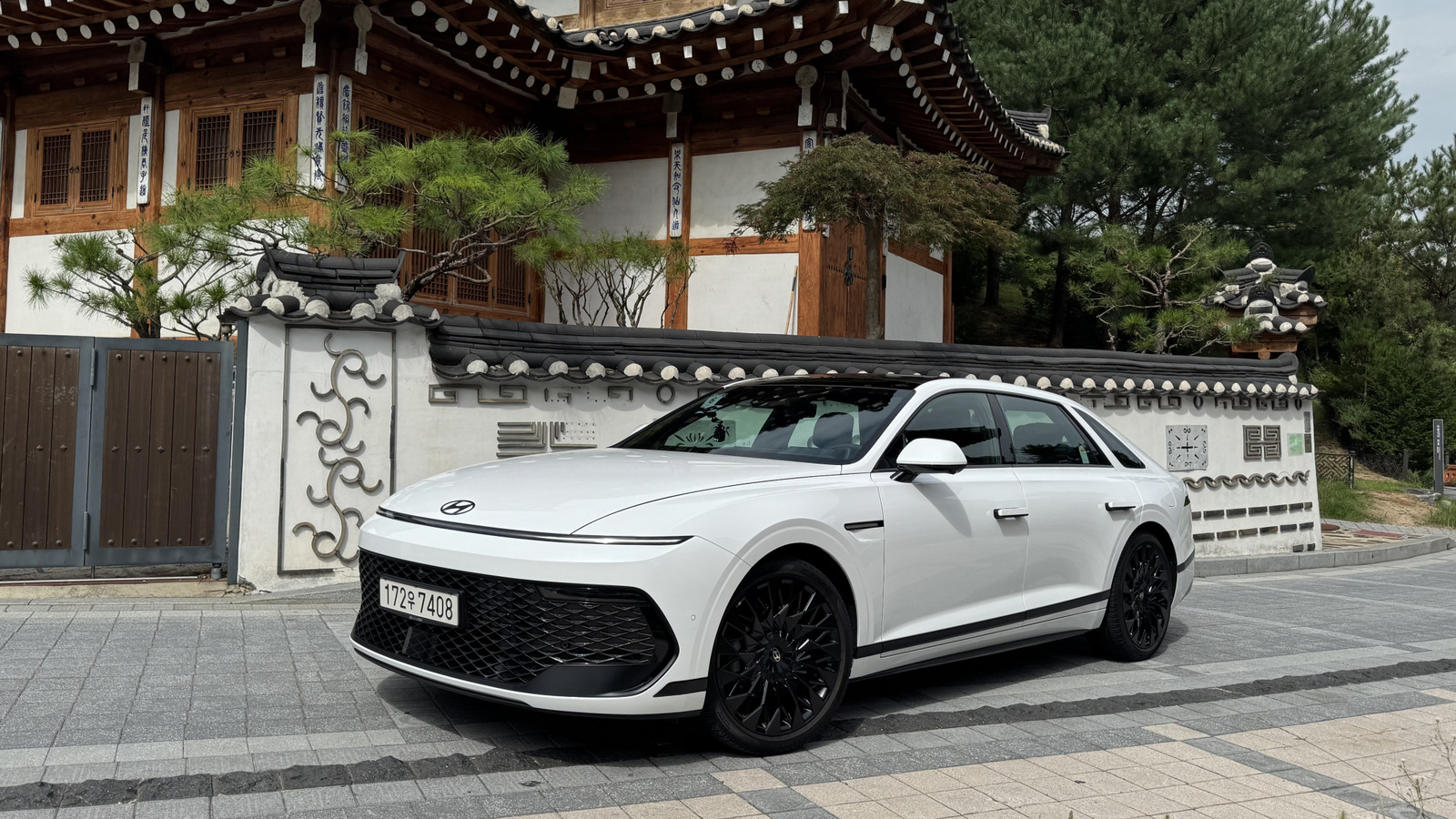
# Korean-Market Hyundai Grandeur Delivers Styling But Falls Short Dynamically
Hyundai's redesigned Grandeur arrives as a handsome midsize sedan targeting Korea's domestic luxury market, but the base engine configuration raises questions about whether the company prioritized aesthetics over driving dynamics. The 195-horsepower turbocharged inline-4 tested here produces a restless sedan that feels disconnected from the road, delivering the bloated steering responses and excessive body roll typical of a traditional American luxury barge rather than a sport-tuned competitor in the segment.
The Grandeur occupies a critical niche for Hyundai in South Korea, where it competes against the Toyota Camry, Honda Accord, and the Kia K5. In this market, the nameplate carries historical weight. Previous generations established the Grandeur as a symbol of mainstream Korean aspirations. The new design language demonstrates Hyundai's commitment to modernizing the platform with a distinctive front grille, proportional body work, and cabin appointments that don't embarrass the price point. Visually, the Grandeur achieves what Hyundai intended.
The driving experience tells a different story. That 195-horsepower four-cylinder engine, likely paired with a conventional automatic transmission, creates sluggish acceleration and uninspiring throttle response. More problematically, the chassis tuning emphasizes comfort over engagement. The steering feels numb rather than communicative. Suspension compliance that might coddle passengers on expressways becomes a liability in tighter corners, where excessive body motion undercuts stability. The overall package reads as a manufacturer prioritizing a soft, wafting quality over the kind of responsive handling that midsize luxury sedans in this price bracket should deliver.
The real problem here isn't the Grandeur's existence or ambition. Hyundai has proven repeatedly with models like the Elantra N and the Ioniq 5 that the company understands performance tuning. The issue is segment strategy. The base four-cylinder configuration appears designed to hit a price target, not establish a compelling driving proposition. Buyers stepping up from economy sedans expect some tangible reward beyond styling and interior materials. They want their input translated into mechanical response.
The alternative powertrains reportedly address this shortcoming more effectively. A hybrid variant and a V6 option both promise better performance dynamics, though Hyundai hasn't confirmed final specifications or availability in all markets. For Korean buyers, these options likely represent where this sedan actually makes sense as a purchase.
The Grandeur's mixed execution reflects a broader industry challenge. Cost pressures push manufacturers toward efficient but uninspiring baseline engines. Comfort-first tuning sells volume in markets skeptical of sporty sedan claims. Hyundai possesses the engineering capability to thread this needle successfully, as its N-branded performance division proves. Here, though, product positioning won out. The car looks the part of a modern luxury sedan. Behind the wheel, it doesn't quite play it convincingly enough, at least not with the turbo four installed.