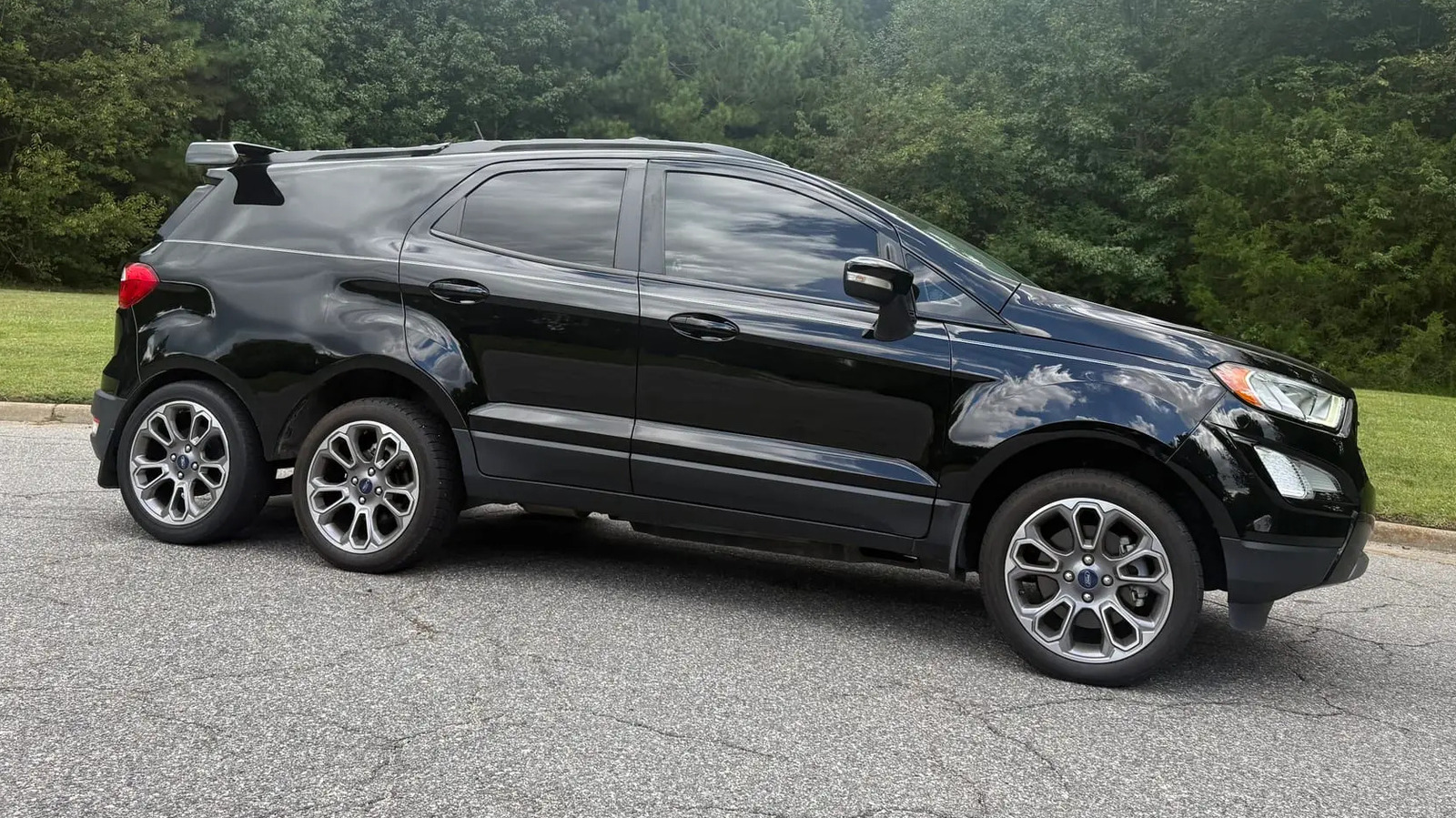
A six-wheeled Ford EcoSport has surfaced for sale, and the verdict from the automotive community is decidedly mixed. This custom creation stretches the already-compact EcoSport platform into something that defies conventional logic and, frankly, practical purpose.
The EcoSport, Ford's entry-level subcompact crossover, seats five passengers and measures 168 inches long with a 2.0-liter EcoBoost engine producing 166 horsepower in most markets. It's designed for affordable urban mobility and modest hauling capacity. Adding two rear wheels fundamentally alters the vehicle's weight distribution, handling characteristics, and structural integrity. The modification requires extending the chassis, reinforcing the frame, and rerouting the driveline to accommodate the extra axle.
Custom six-wheeled vehicles exist for specific purposes. Mining operations, military transport, and heavy-duty agricultural work deploy six-wheel configurations because the extra contact patch distributes massive loads across more rubber. Adding wheels to a 2,800-pound commuter crossover serves no engineering function. It worsens acceleration, reduces fuel economy, increases unsprung weight, and complicates steering feel.
The EcoSport already struggles with identity in the global market. Ford discontinued it in North America in 2022 after tepid sales, though the model persists in India, Brazil, and Southeast Asia where budget-conscious buyers prioritize affordability over features. The EcoSport competes against the Honda HR-V, Hyundai Kona, and Mazda CX-30 in markets where it remains available. None of those competitors sell custom six-wheel variants because there's no demand. Buyers shopping the subcompact crossover segment want fuel efficiency, reliability, and low purchase prices. They don't want mechanical oddities that complicate maintenance and void warranties.
The real story here reflects a broader phenomenon in automotive culture. YouTube and social media reward extreme modifications that generate views, not vehicles people actually want to drive. The six-wheeled EcoSport exists because someone had the tools, time, and inclination to build it, not because it solves any problem. It's a novelty. Custom car shows thrive on novelties, but novelty isn't desirability.
This particular build highlights how easily a practical vehicle can become impractical. The EcoSport's value proposition depends on simplicity and affordability. Adding a second rear axle eliminates both. Parts availability becomes a nightmare. Repair shops can't service a six-wheeled EcoSport because none exist in their technical training. Insurance companies don't know how to classify it. Resale value approaches zero for anyone not buying it as a conversation piece.
The automotive market has shifted decisively toward electrification, autonomous systems, and connected services. Every major manufacturer invests billions in these areas. Meanwhile, custom shops still waste engineering talent on six-wheeled Ford EcoSports. The disconnect reveals how market forces and hobbyist interests have fundamentally diverged.
Whether this particular vehicle finds a buyer likely depends on whether someone views it as art, comedy, or investment. None of those perspectives justify owning it for actual transportation.