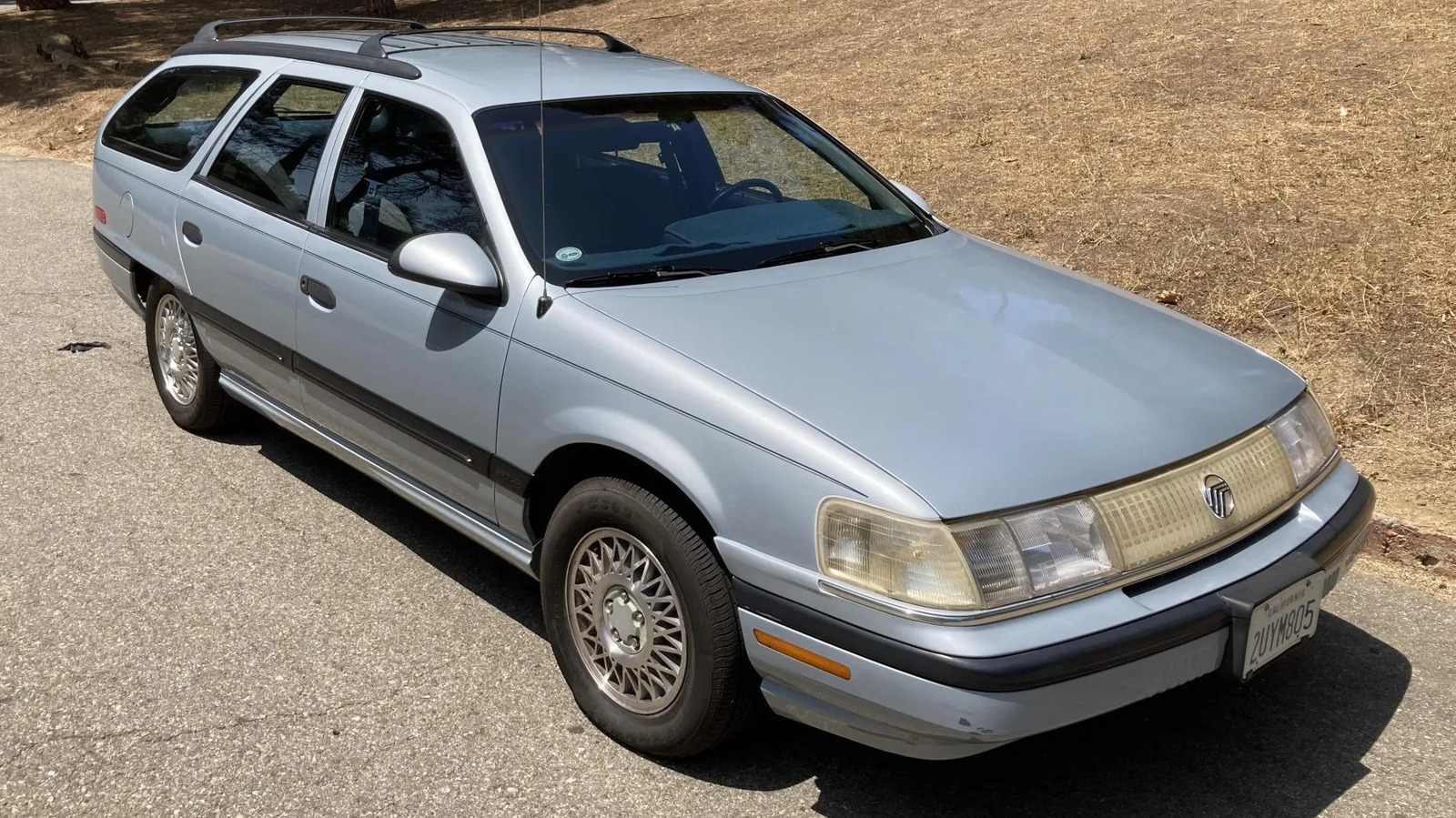
# A 1990 Mercury Sable Wagon Reveals What the Forgotten Nameplate Actually Meant
Mercury's Sable nameplate has largely vanished from automotive consciousness, but a 30-plus-year-old wagon recently reminded one journalist why this mid-size sedan once mattered. The 1990 Mercury Sable wagon represents a specific moment when Ford's luxury division tried to position itself as practical and approachable rather than purely aspirational.
The Sable arrived in 1986 as Mercury's answer to the Ford Taurus, sharing the same platform and running gear but with distinct styling and positioning. Mercury chose the name to invoke refinement and elegance. While the sable itself is a small, dark-furred weasel prized for its pelt, the automaker clearly aimed for connotations of luxury and sophistication rather than literal animal reference. The name worked better than you might expect in a lineup that also included the Capri, Cougar, and Lynx.
By 1990, when this particular wagon rolled off the assembly line, the Sable had established itself as a solid alternative to mainstream family cars. The wagon configuration stretched practicality to its limits while maintaining the rounded, aerodynamic styling that defined mid-1980s and early-1990s Ford products. Mercury wagons offered genuine cargo space without the height and bulk of early SUVs. They appealed to families who wanted something more upscale than a Taurus wagon but less pretentious than Continental or Town Car models.
The 1990 Sable wagon featured Mercury's typical touch points. A more upright grille distinguished it from Taurus models. Interior trim leaned toward wood-grain accents and softer plastics than Ford's more utilitarian approach. The driving experience emphasized comfort over sport, with compliant suspension tuned for highway cruising rather than spirited handling.
Under the hood sat either a 3.0-liter V6 or a 3.8-liter V6, paired with an automatic transmission. Performance was adequate rather than impressive. Fuel economy barely cracked 20 mpg on the highway. What buyers actually purchased was a roomy, reliable hauler with Mercury's slightly premium positioning.
Mercury discontinued the Sable in 2005 after two generations. The nameplate failed to evolve with market preferences that increasingly favored crossovers and SUVs over traditional sedans and wagons. By the time the Sable vanished, consumers had already moved decisively away from wagons toward vehicles with higher seating positions and boxy proportions. The crossover revolution made the Sable's entire category obsolete.
This 1990 example serves as a snapshot of a different automotive era. It proves the Sable was never a performance car or a luxury statement piece. It was honest family transportation dressed up with Mercury's mid-tier badge and minor styling flourishes. The wagon format emphasizes that practicality was its core mission.
Today's automotive landscape offers no direct Sable equivalent in Mercury's lineup, partly because Mercury itself ceased operations in 2011. Ford consolidated its brands, leaving Lincoln as its luxury division and Ford itself handling mainstream models. The Sable's niche has been completely absorbed by crossovers and compact SUVs that offer superior practicality, higher seating positions, and better visibility.
This time capsule wagon reminds enthusiasts that not every nameplate needs to reference apex predators or exotic concepts. Sometimes the best car names simply convey a promise. The Sable promised refined practicality for families, and for a generation of buyers, it delivered exactly that.