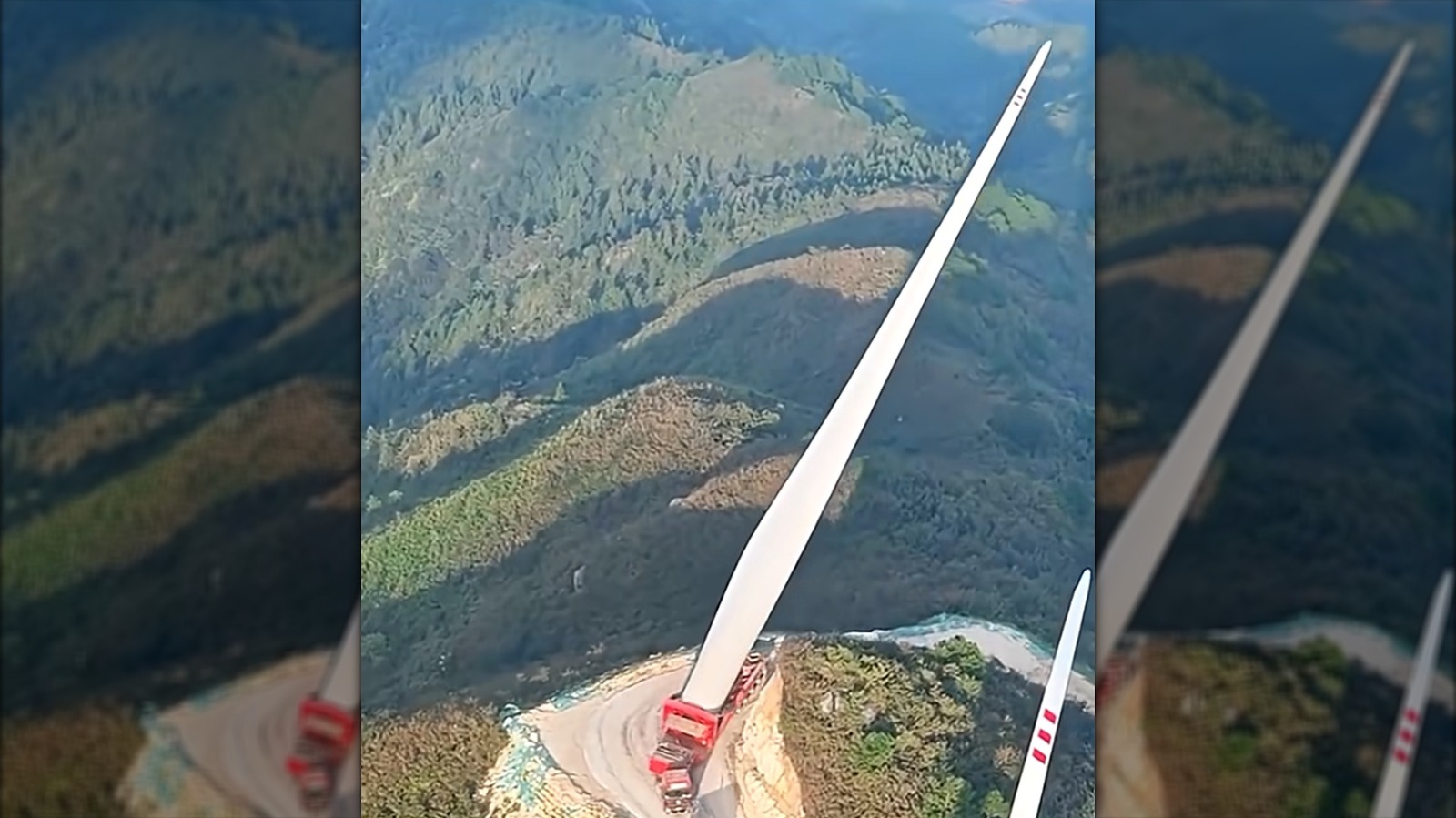
# Oversize Load: Moving a 387-Foot Wind Turbine Blade Through Mountain Terrain Tests Logistics and Driver Skill
Transporting a 387-foot wind turbine blade up narrow mountain roads represents one of the most demanding logistics operations in modern trucking. The sheer scale of the cargo, combined with treacherous terrain and minimal margin for error, demands exceptional driver skill and meticulous route planning.
Wind turbine blades of this length push transportation to its limits. A 387-foot blade extends longer than a football field. When mounted on a specialized tractor-trailer, the load becomes a moving architectural oddity that cannot fit through standard highway tunnels, cannot navigate sharp turns at normal speeds, and cannot operate safely in high winds. The blade must be transported during specific weather windows and requires escort vehicles, road closures, and police coordination.
Mountain roads amplify the complexity. Narrow switchbacks, variable grades, and hairpin turns designed for standard vehicles become near-impossible for a rig carrying cargo that exceeds 150 feet in length. The driver loses visual contact with the blade's trailing end. Banking curves can cause the blade to swing outward and strike canyon walls or cliff edges. Descent on steep grades requires brake management over distances where overheating becomes a real hazard.
Drivers operating these loads come from a specialized subset of the trucking industry. They train extensively on high-consequence hauling. Oversize load operations demand constant communication with spotters who walk alongside the truck, flag oncoming traffic, and provide real-time guidance on clearance. A single miscalculation costs hundreds of thousands of dollars in equipment damage and can trigger catastrophic accidents.
Wind energy infrastructure expansion drives demand for blade transportation. Modern turbine installations require blades that push manufacturing and logistics boundaries. As renewable energy capacity grows across the United States and globally, more blades must reach increasingly remote locations where wind resources exist. Mountain regions in Colorado, Wyoming, and other western states host significant wind farms, necessitating exactly these types of hauls.
The logistics chain starts long before the truck leaves the manufacturing facility. Route planners use specialized software to identify roads capable of handling the load. They measure overhead clearances at every overpass, underpass, and utility line. They identify turnarounds for emergencies. They calculate grade percentages to ensure trucks can manage descent without exceeding brake temperature limits. A single mountain route can take weeks to fully survey and document.
Cost per load runs into five figures for specialized transportation. Companies shipping turbine components factor transportation expense directly into project economics. Delays compound rapidly when a load gets stuck, requiring equipment repositioning or road reconstruction. Weather forecasts become critical planning tools. Strong winds can halt operations completely.
This work represents the unglossed reality of renewable energy transition. Wind farms do not magically appear on mountaintops. Every blade requires physical movement from factory to installation site. Drivers navigating impossible roads with cargo that defies conventional transportation represent the human cost of scaling clean energy infrastructure. The concentration and skill required transforms a standard trucking operation into a specialized, high-stakes profession where mistakes cascade quickly.