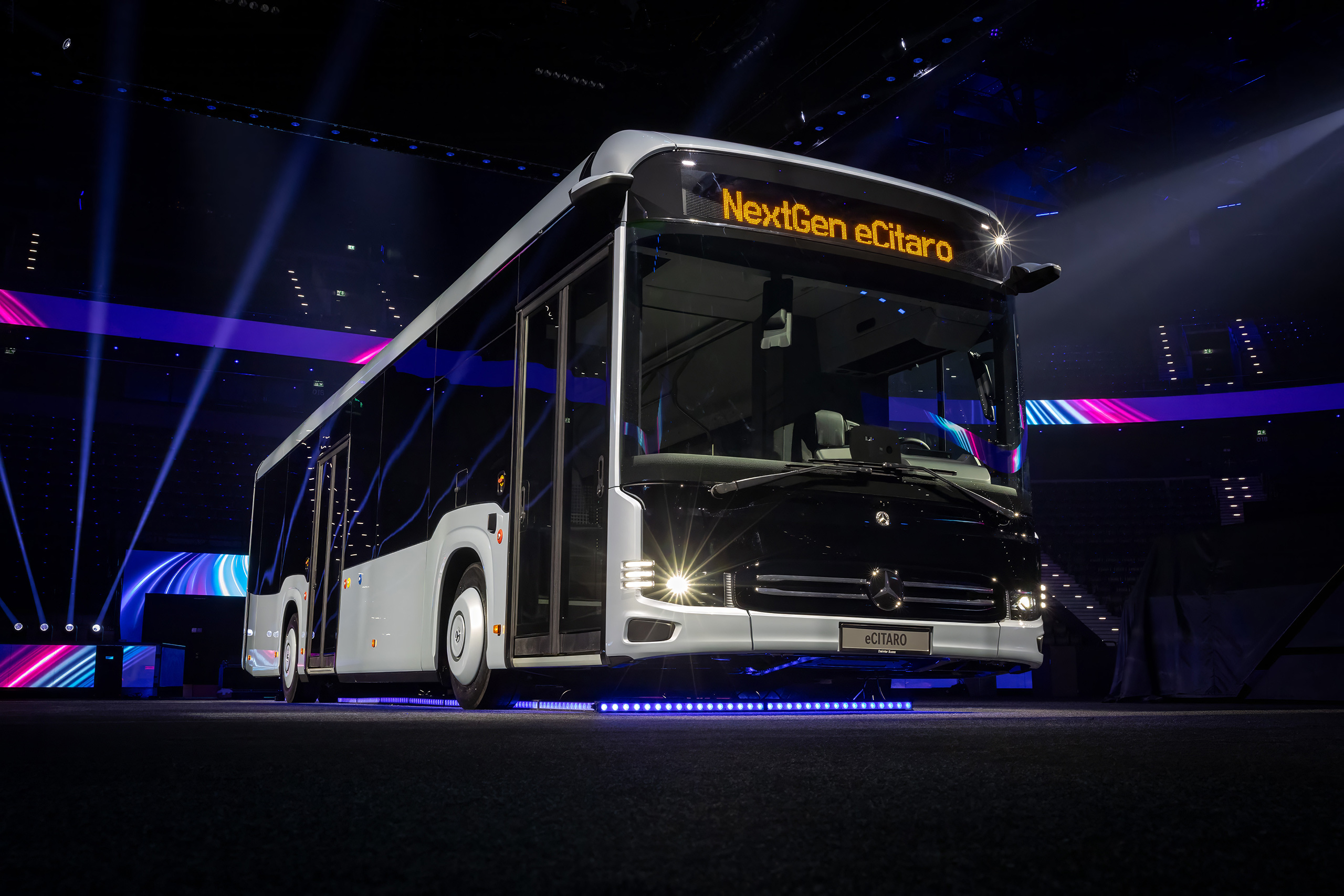
Daimler Buses unveiled the next-generation Mercedes-Benz eCitaro in near-production form, the company's first city bus engineered from the ground up as electric rather than adapted from a diesel platform. The bus will launch in 2028.
The new eCitaro uses lithium iron phosphate battery cells instead of the nickel-manganese-cobalt chemistry in today's model. The articulated version weighs around 750 kg less than the current generation. Battery capacity scales in 50 kW/h increments, with solo buses carrying six to 12 packs and charging at up to 450 kW via pantograph or rail.
The bus uses ZF's AxTrax 2 LF portal axle on low-floor models, delivering up to 360 kW, which allows the articulated version to run with only one driven axle. A new controller manages braking and recuperation on each wheel individually.
Production will occur in France, Germany, and the Czech Republic. The vehicle will premiere at Busworld Europe in October 2027.
The current eCitaro, built on a diesel-derived platform, has been delivered more than 4,600 times.
Daimler Buses CEO Till Oberwörder called for the EU to delay its coach CO₂ target to 2033, citing slow charger rollout. He stated the company is committed to developing and producing the next generation in Europe and called for consistent regulatory rules across borders.