Julian Gonsior, Director of Product Management for Automated Driving at HERE Technologies, says OEMs developing software-defined vehicles (SDVs) often use processes built for hardware-led programs, causing software integration and real-world validation to surface too late in development.
Traditional vehicle programs center prototypes as the starting point, forcing software work to wait for physical electronic control units and hardware to arrive. Integration problems between components from multiple suppliers and edge cases only appear when software meets actual roads, real signage, and real traffic. By that stage, fixes become expensive.
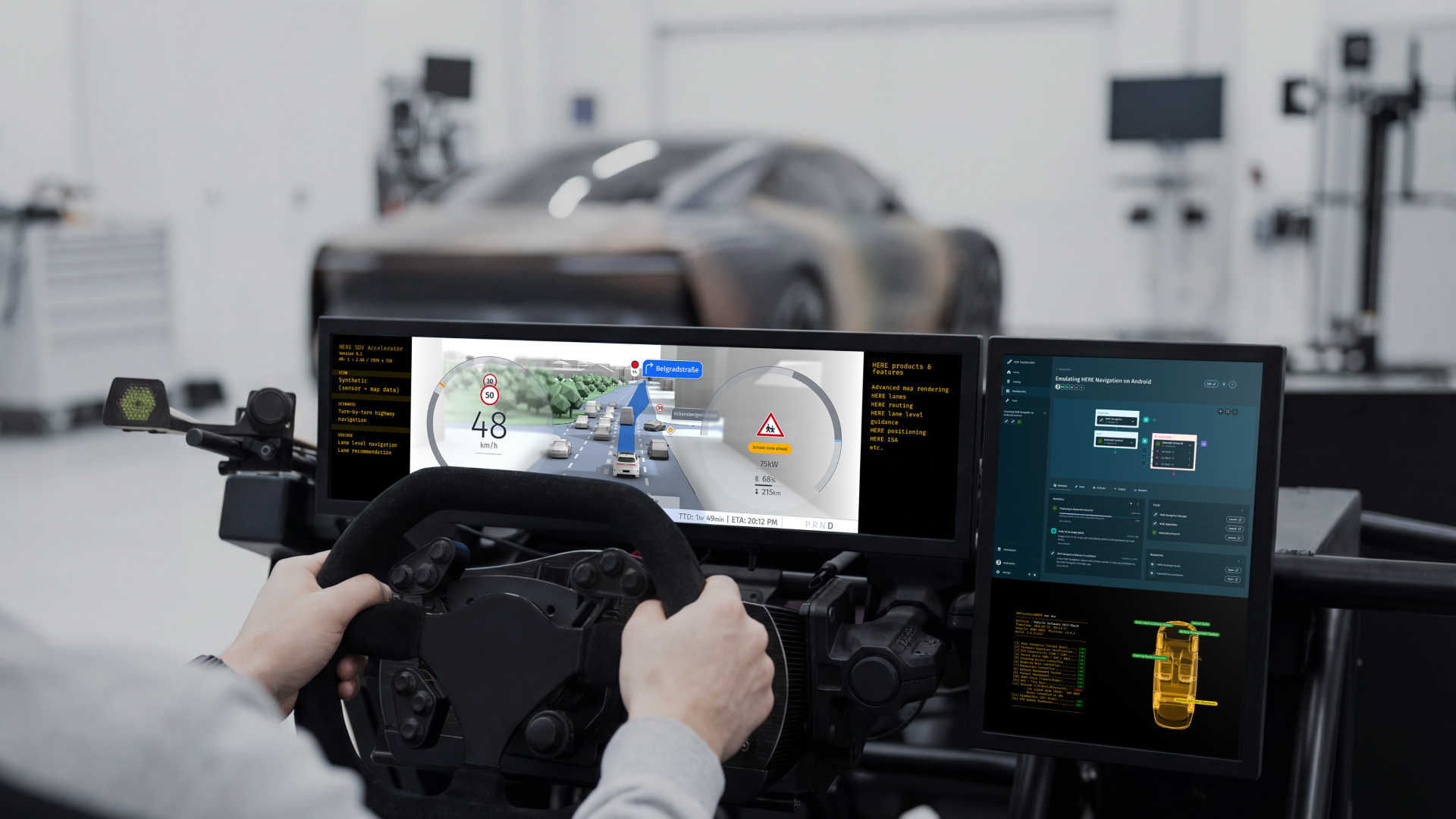
Virtual development moves this work earlier. OEMs can run software on virtual ECUs in the cloud before physical prototypes exist, pre-integrate supplier components, and generate test scenarios directly from real-world location data. HERE and AWS built SDV Accelerator, an open virtual environment where OEMs run code on virtual targets long before hardware arrives. A module called SceneXtract converts plain-language test descriptions into simulation-ready scenes drawn from actual locations.
Gonsior states that software architecture should influence E/E architecture, sensor sets, and compute budgets from day one of a program, not the reverse. Validation strategy should be defined early as a design input, not treated as a final exam.
Virtual development can handle software integration, functional development, scenario coverage, regression testing, and training data generation. HERE projects up to 70 percent faster development cycles, up to 30 percent lower R&D costs, and up to 7x more testing capacity through virtual methods. However, physical hardware remains essential for final sensor behavior, vehicle dynamics, homologation, and real-world confidence.
OEMs that shorten SDV cycles will treat development as a data loop rather than sequential gates, go virtual-first from day one, ground every test in real-world data, and maintain openness with their own architecture and data control. Those still waiting for hardware prototypes to validate software will continue facing late-stage delays.