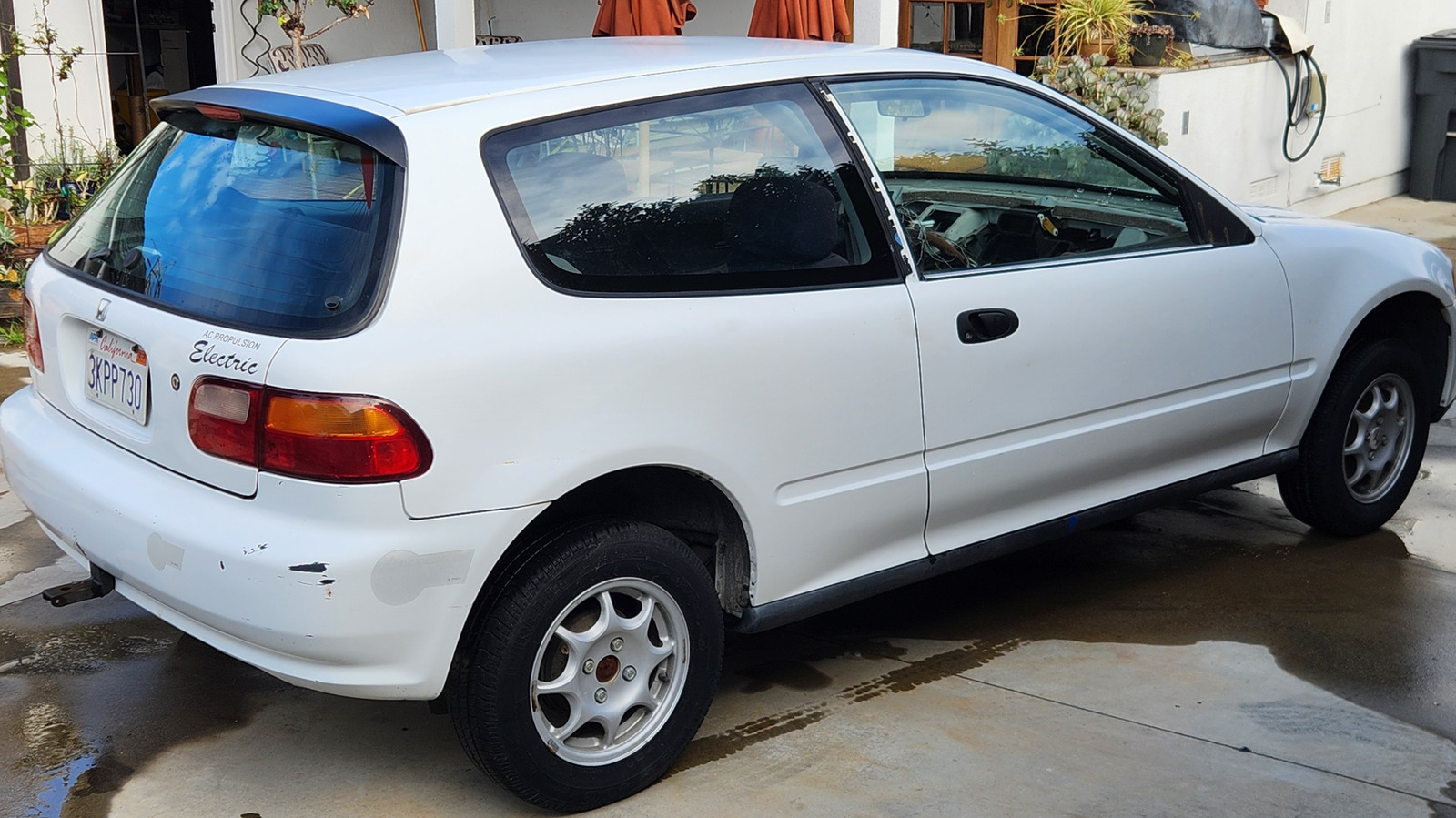
Tom Gage, former CEO of AC Propulsion, sold a 1994 Honda Civic this past weekend that holds a direct place in Tesla's lineage. AC Propulsion co-founder Alan Cocconi converted the Civic into an electric proof-of-concept in 1994, filling it with lead-acid batteries and removing its engine and tailpipe.
The systems tested in this Civic evolved into the AC Propulsion tzero, debuted in 1998. Tesla later licensed AC Propulsion's technology in 2004, which eventually powered the original Tesla Roadster in 2008.
Cocconi designed an inverter module that could convert DC current from the battery to high-frequency AC for the motor, and reverse the process during charging. This 1994 Civic ran a 200-horsepower power electronics unit that combined the motor, inverter, charger, and 12-volt DC power supply. Modern EVs have this bidirectional charging capability, though it remains uncommon. The 2027 Ford Fathom will offer 10-kilowatt vehicle-to-home power without a wall inverter, while AC Propulsion cars could deliver up to 20 kilowatts.
The lead-acid batteries weighed 1,200 pounds and exceeded the Civic's gross vehicle weight limit. AC Propulsion initially fitted a trailer carrying a gas generator to extend range. They experimented with a modified Generac generator before switching to a Kawasaki Ninja 250 engine running at 11,000 rpm, which the Civic achieved 81 mpg. Later adoption of lithium-ion laptop batteries eliminated the need for the trailer.
When AC Propulsion added lithium-ion batteries to the tzero in 2003, range jumped from 80-100 miles to 300 miles with a 600-pound weight reduction. This caught the attention of Tesla co-founder Martin Eberhard, who became an early investor. AC Propulsion told Eberhard they lost $100,000 on each tzero and would need to charge $220,000 to break even. Gage introduced Eberhard to Elon Musk, and the two founded Tesla.
AC Propulsion later converted Scion xBs into electric vehicles called the eBox, choosing the model for its practicality and rear-seat space. When Nissan engineers visited multiple times to examine the eBox, Gage suspected industrial espionage. "Turns out, what they were really doing was scoping out what we were doing," he says. Nissan released the Leaf a year or two later.
Gage purchased the Civic for $100 in 2011 when it sat in a back lot at AC Propulsion. An employee had partially disassembled it attempting to convert it into a race car but never finished the project.