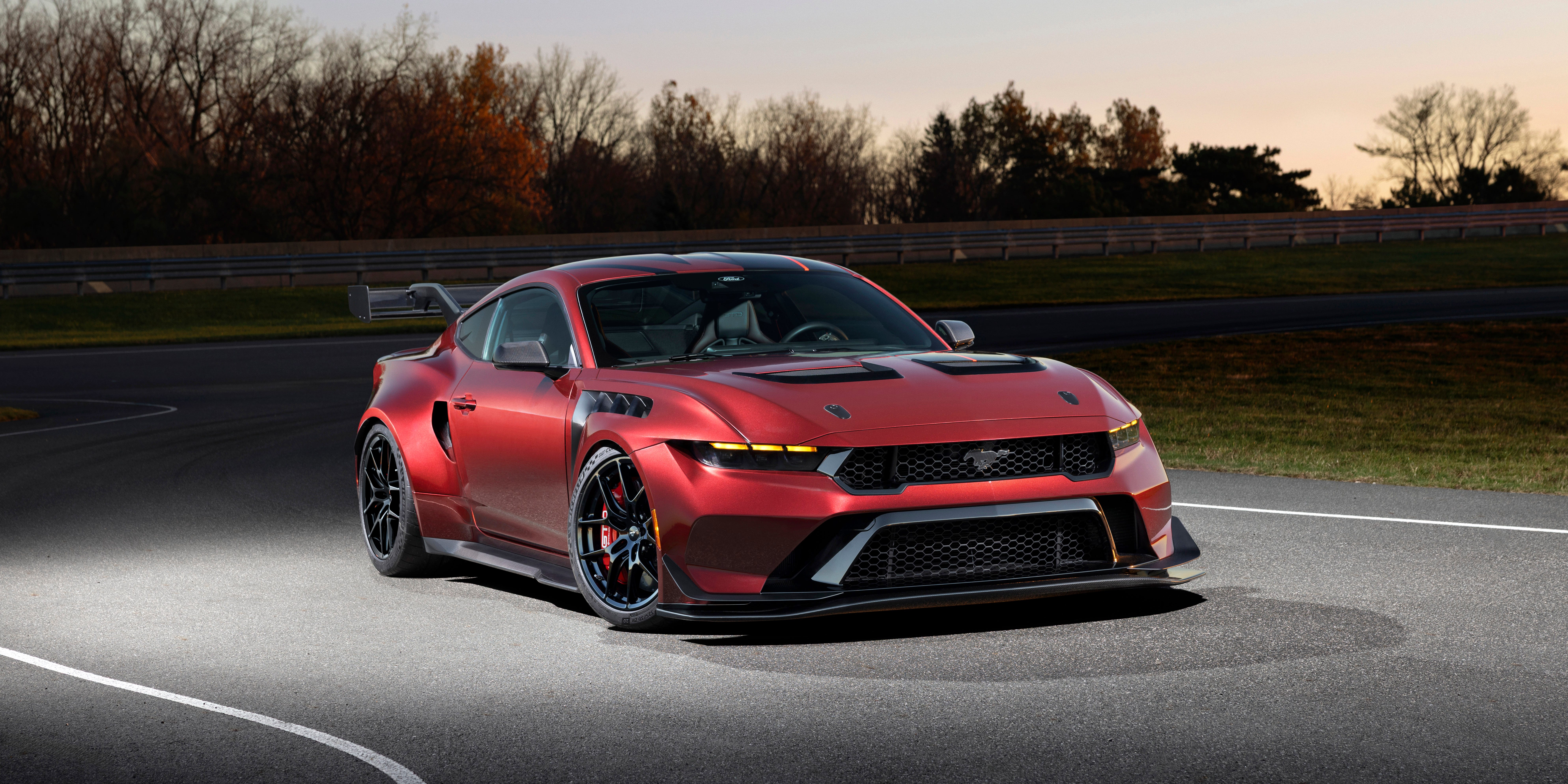
The 2028 Ford Mustang GTD uses a supercharged 5.2-liter V-8 that produces 815 horsepower, far exceeding the 550 horsepower of the race-derived Mustang GT3 that competes in IMSA and at Le Mans. Power feeds to an eight-speed dual-clutch automatic transmission. The GTD sits on a racing-derived pushrod rear suspension and sports carbon-fiber bodywork and active aerodynamics. At the Nürburgring Nordschleife, only Mercedes's AMG One hypercar beats the GTD among production cars.
For 2028, Ford introduces the 1901 special edition with Royal Red exterior paint and Mahogany Red leather, replacing the Spirit of America model. Production will be extremely limited, though Ford has not announced pricing. Magnesium wheels are now available after earlier manufacturing delays. The company says the wheels save 50.3 pounds of unsprung mass. The GTD's paddle shifters, now 3D-printed from titanium, have been redesigned. Ford sourced the titanium material from retired Lockheed Martin F-22 fighter jets. A new stripe design joins the order sheet, and the Liquid Carbon special edition now includes teal accenting.
In testing, the GTD reached 60 mph in 2.8 seconds and covered the quarter-mile in 10.6 seconds at 133 mph. The Chevrolet Corvette ZR1 and Porsche 911 GT3 RS both accelerated faster to 60 mph, in 2.2 and 2.7 seconds respectively. The GTD delivered surprisingly civilized on-road ride quality and supremely balanced handling, though testers wanted more steering feedback. EPA fuel economy ratings are 10 mpg city, 17 mpg highway, and 12 mpg combined. The base price is $327,960.
The GTD seats two in Recaro bucket seats with no rear seats. The cabin uses suede, leather, and carbon fiber. A 12.4-inch digital gauge cluster and 13.2-inch touchscreen infotainment display come standard, with Apple CarPlay and Android Auto. Driver-assistance features include lane-keep assist and automatic emergency braking. The trunk contains suspension and cooling components with space for small soft luggage.