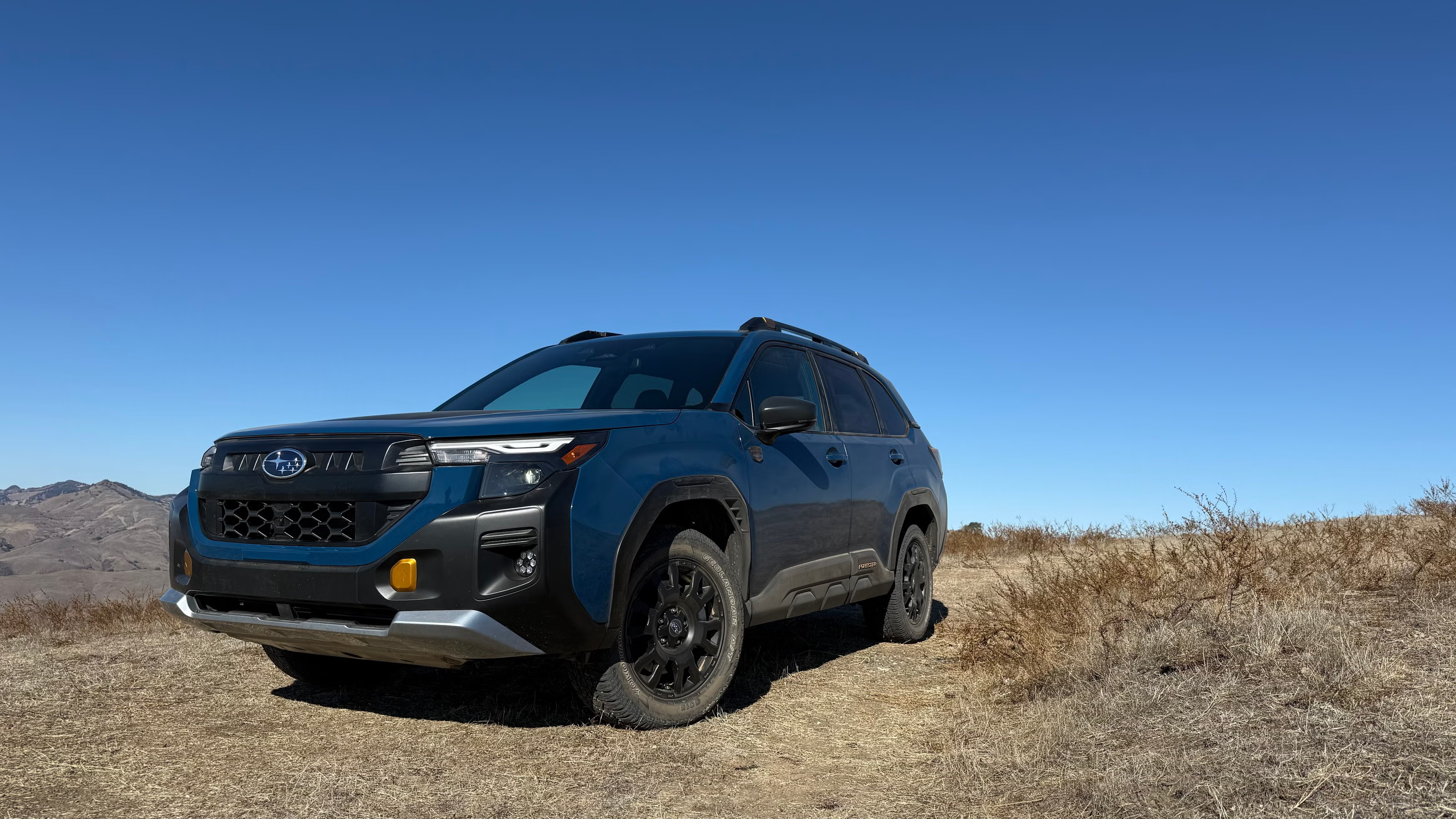
Subaru introduced the 2027 Forester Wilderness Hybrid by combining its hybrid powertrain with the Wilderness trim's off-road upgrades. The model pairs a 2.5-liter Atkinson-cycle flat-four engine and 1-kWh battery pack for 194 horsepower, delivering 33 mpg city and 29 mpg highway.
The Forester Wilderness Hybrid carries the same approach, break-over, and departure angles as the nonhybrid Wilderness model (23.5, 20.6, and 25.5 degrees), along with 9.3 inches of ground clearance and Yokohama Geolander all-terrain tires. Testing confirmed the all-terrain tires handled substantial ruts and hill descents on a technical off-road course.
Pricing runs $1,000 more than the base Forester Wilderness. The hybrid loses 5 mpg in city driving versus the standard Forester Hybrid but delivers a 9 mpg advantage over the nonhybrid Wilderness model's 24 mpg city rating. Daily driving behavior mirrors that of the standard Forester Hybrid, with the continuously variable automatic transmission and relaxed acceleration proving acceptable for most users.
Two significant drawbacks emerged. The hybrid lacks a spare tire, as hybrid components occupy that space, limiting buyers' trail options during a flat. Towing capacity drops to 1,500 pounds from the nonhybrid Wilderness model's 3,500 pounds. Both limitations affect certain use cases but may not impact average buyers.
The Forester Wilderness Hybrid competes with the Toyota RAV4 Woodland hybrid and Honda CR-V Trailsport hybrid. The Subaru is the only one of the three with conventional full-time all-wheel drive. Subaru equips the cabin with synthetic StarTex interiors and a synthetic steering-wheel cover for easy cleaning.