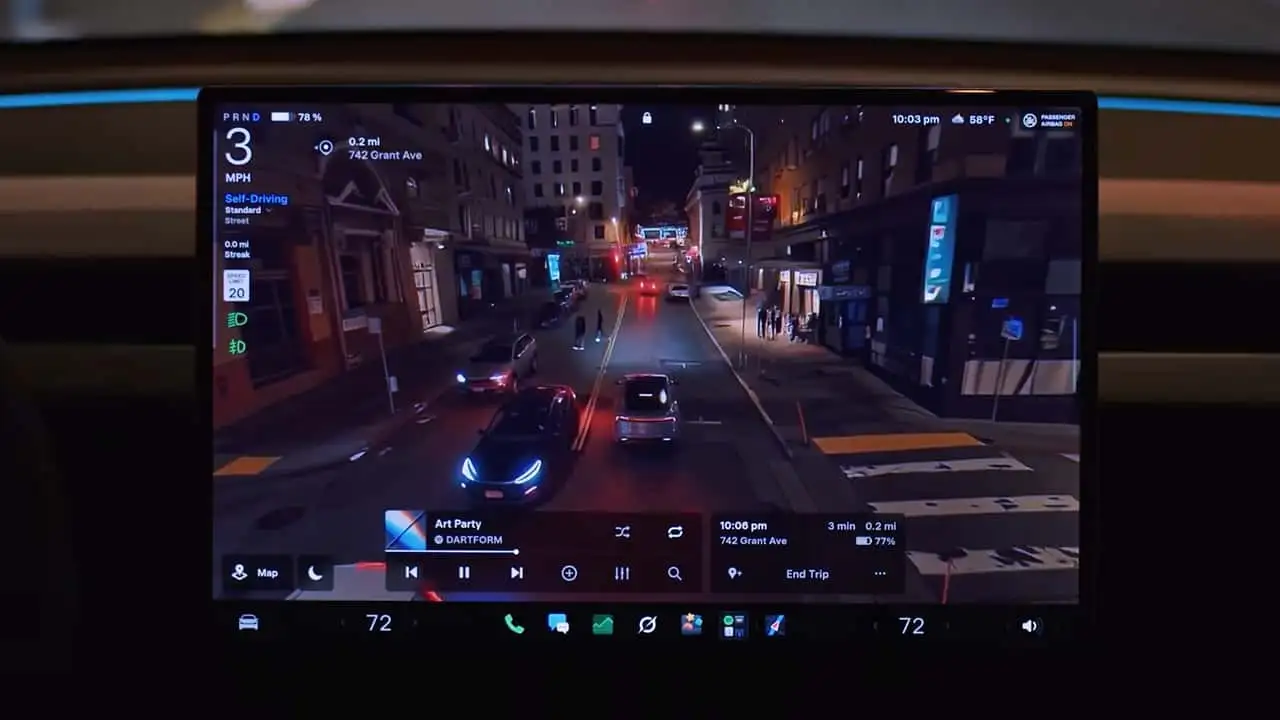
Tesla has rolled out Full Self-Driving v15 and claims a 25-fold drop in critical interventions, but has not published the baseline figure needed to verify the claim. The update introduces a new vision encoder trained on millions of internet videos, shared across FSD, Robotaxi, and the Optimus humanoid robot. Tesla promises improved detection of road signs, debris, small animals, and potholes, plus better handling in school zones and poor weather.
The changes address documented weaknesses. In a September test by Brussels non-profit Johanna.be, FSD misread speed-limit signs in 55% of 30km/h zones, displaying 50km/h instead and averaging 44km/h. Pothole avoidance, now featured in v15, was first promised in 2019.
The update requires AI4 hardware. Early-access owners received it on November 21-22. Chief Executive Elon Musk indicated a wide release will follow in December.
The US National Highway Traffic Safety Administration is investigating roughly 2.9 million FSD-equipped vehicles over traffic-law violations and reviewing allegations that Tesla Robotaxis speed through active school zones.
Crowdsourced data suggests FSD v14 could manage a couple of thousand miles between critical interventions. If the 25x multiplier held across the fleet, v15 would reach around 50,000 miles, but this remains unverified.
Two features complicate the safety narrative. FSD will now slow for speed cameras, with drivers able to mute specific cameras after overriding them twice. Tesla is also decreasing driver-monitoring strictness in higher-speed profiles, even as it tightens monitoring in Europe at regulators' request.
A new visualization tool called Reality View uses generative rendering to show drivers what FSD plans to do with less computing power than before. Early reports on actual driving performance are mixed, with one owner noting more caution around pedestrians and another reporting unchanged performance with an odd wide swing on a left turn.
The update leaves millions of older HW3 vehicles behind. Owners on HW3 and HW2 were promised full autonomy but now find themselves with expensive cars stuck below SAE Level 2+ capability. Owner litigation in China has already resulted from this hardware divide.
Regulators in China, California, Germany, and South Korea have scrutinized Tesla's FSD marketing. South Korea accuses Tesla of knowingly selling the technology to consumers with vehicles not legally permitted to use it because of their Chinese origin.
Evidence of real-world performance will come from crowdsourced fleet data once the December release reaches owners at scale.