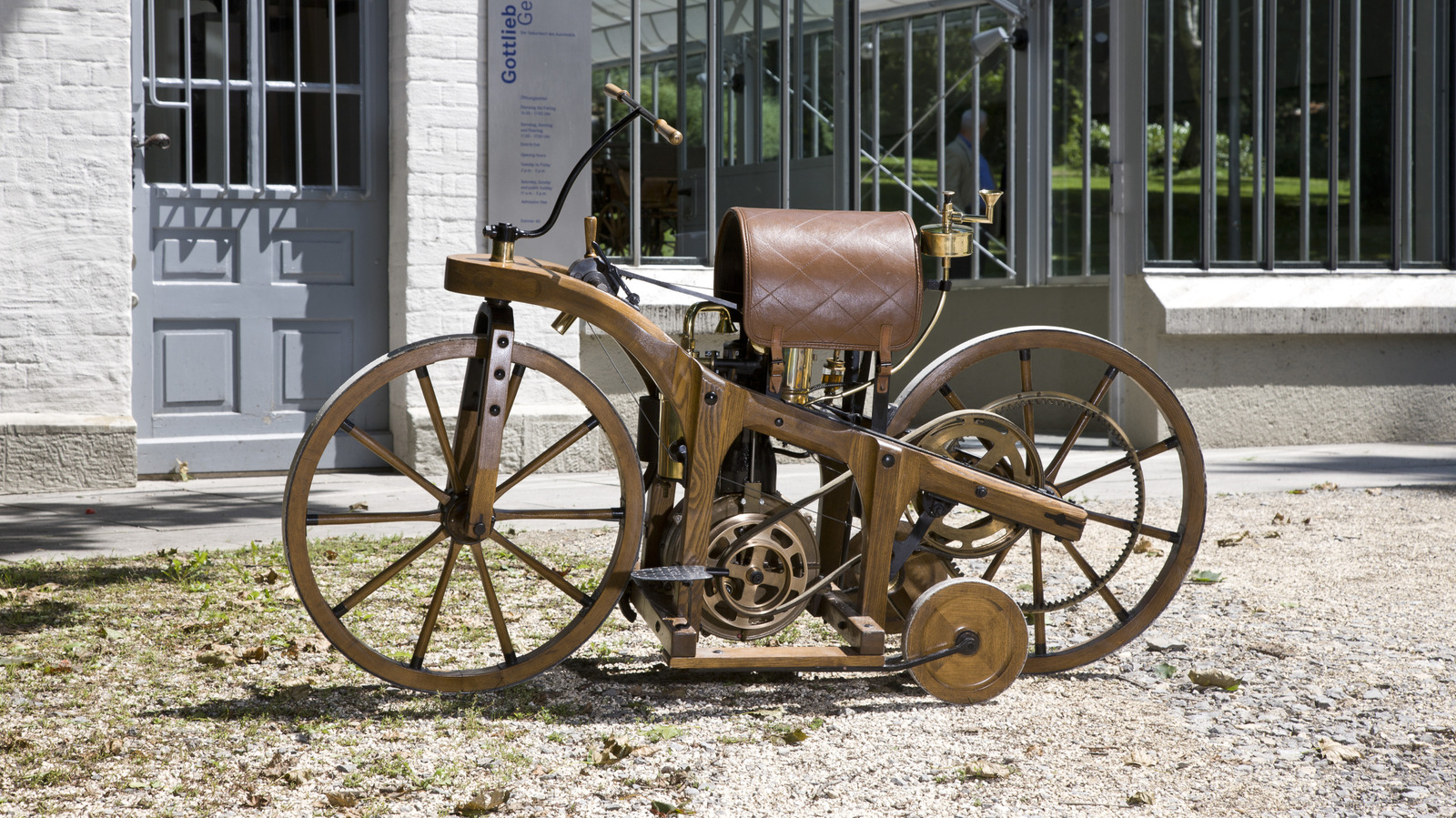
Wilhelm Maybach stands as one of automotive history's most prolific engineers, yet his foundational work on the first gas-powered motorcycle remains overshadowed by the luxury brand that later carried his name. Long before Mercedes-Benz established the Maybach line as its ultra-premium subdivision, Maybach pioneered internal combustion engine technology that would reshape personal transportation forever.
In 1885, Maybach collaborated with Gottlieb Daimler to develop the Reitwagen, widely recognized as the world's first gasoline-powered motorcycle. This machine represented a watershed moment in engineering. Rather than relying on steam or animal power, the Reitwagen used a single-cylinder four-stroke engine producing roughly 0.5 horsepower. The bike featured a wooden frame reinforced with iron, pneumatic tires, and a leather saddle. It worked. More importantly, it proved the internal combustion engine could power a two-wheeled vehicle efficiently.
The partnership between Maybach and Daimler proved transformative. While Daimler handled business and commercialization, Maybach focused on mechanical innovation. This dynamic created the foundation for what became Daimler-Motoren-Gesellschaft, the company that eventually produced the first Mercedes automobiles in the 1890s. The motorcycle served as their laboratory for solving the core engineering challenges of portable gasoline power.
Maybach's contributions extended far beyond that first bike. He developed the honeycomb radiator, refined carburetor design, and perfected ignition timing mechanisms. His work on lightweight, high-revving engines established principles still relevant to modern internal combustion engineering. By the early 1900s, Maybach had become chief engineer at Daimler and later founded Maybach-Motorenbau, producing engines for luxury automobiles and aircraft.
The Maybach brand identity reflects this heritage. When Mercedes-Benz introduced the modern Maybach line in 2002, executives positioned it as a ultra-luxury competitor to Rolls-Royce and Bentley. The current Mercedes-Maybach S-Class and GLS represent the apex of Mercedes engineering, featuring handcrafted interiors, bespoke customization options, and price tags exceeding $200,000. These vehicles carry Wilhelm Maybach's name forward as a symbol of precision craftsmanship and technical excellence.
Yet the lineage runs deeper than branding. Wilhelm Maybach's obsession with refining mechanical systems, reducing weight, and maximizing efficiency permeates modern Maybach vehicles. The same engineering philosophy that guided that 1885 motorcycle experiment now drives decisions about suspension tuning, powertrain calibration, and material selection in contemporary luxury cars.
The Reitwagen never achieved mass production. Only a handful were built before Maybach and Daimler shifted focus to four-wheeled automobiles. The motorcycle served its purpose as proof of concept. It validated that small, portable gasoline engines could propel vehicles without the bulk and complexity of steam equipment. Within a decade, the automobile industry had adopted internal combustion engines as the standard. Maybach's motorcycle innovation became foundational to transportation as we know it today.