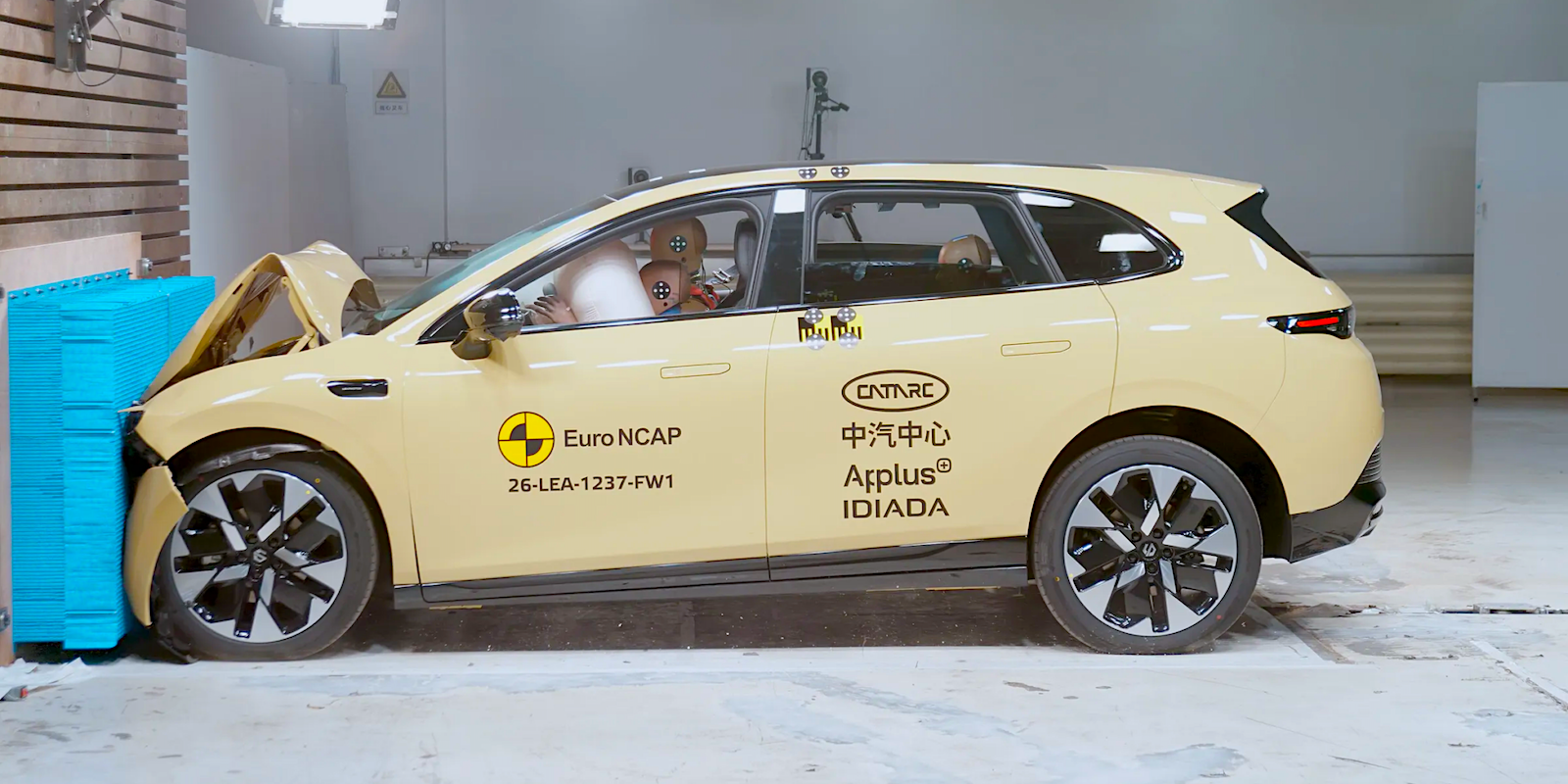
Chinese automakers continue to demolish Western preconceptions about their safety standards. GAC, Geely, and Leapmotor have all achieved top Euro NCAP ratings, proving that Chinese EV manufacturers now meet the world's most rigorous crash testing protocols.
Euro NCAP stands as Europe's gold standard for vehicle safety assessment. The test battery includes frontal offset crashes, side impacts, pole strikes, and pedestrian protection evaluations. A five-star rating requires exceptional performance across all categories. Chinese brands traditionally scored poorly on these tests just five years ago, reinforcing a narrative that cutting corners on safety was standard practice in the Chinese auto industry.
That narrative no longer holds water.
GAC, the Guangzhou Automobile Group, launched the Aion line of battery electric vehicles that now carry five-star Euro NCAP credentials. Geely, which owns Volvo and Polestar, engineered its electric offerings with Swedish safety DNA embedded in the design philosophy. Leapmotor, backed by Geely and Volvo technology partnerships, demonstrated that affordable EVs need not sacrifice crash protection.
The implications run deep across the global EV market. Tesla and legacy automakers can no longer claim an automatic safety advantage based on brand heritage alone. When a Leapmotor sedan passes the same Euro NCAP gauntlet as a BMW or Mercedes, pricing and range become the primary differentiators, not engineering rigor.
Geely's success matters because the brand already sells in Europe under the Geometry nameplate. Top safety ratings remove a critical barrier to market expansion. Leapmotor, still relatively unknown outside China, gains credibility for its expansion into European markets. GAC competes primarily in China but uses Euro NCAP validation as proof of engineering competence for future global ambitions.
This pattern reflects a broader maturation in the Chinese EV ecosystem. First-generation startups like Nio and XPeng burned through capital on performance metrics and autonomous features while treating safety as an afterthought. The latest generation, backed by established automakers with legacy operations, treats safety ratings as table stakes, not differentiators.
Battery technology standardization also plays a role. Chinese manufacturers now source cells from CATL and BYD, suppliers that meet international quality standards. Early Chinese EVs suffered from inconsistent battery management and integration. Today's platforms embed the same redundancy and monitoring systems found in German and Japanese vehicles.
The five-star results don't mean Chinese EVs are suddenly perfect. Euro NCAP testing covers specific crash scenarios. Real-world safety depends on driver behavior, road conditions, and maintenance. However, the ratings prove that Chinese automakers can engineer vehicles that meet Western safety expectations in controlled laboratory conditions.
For buyers, this shifts the calculus. A GAC, Geely, or Leapmotor EV now competes on equal safety footing with established brands. Price advantage becomes the primary attraction. A five-star Chinese EV undercuts a five-star German EV by 30 to 50 percent in many segments.
Western automakers will respond by emphasizing autonomous features, software updates, and brand cachet. Toyota and BMW didn't lose market share to price-cutting competitors overnight. However, the Euro NCAP results eliminate the easiest argument against Chinese EVs: that they're unsafe.