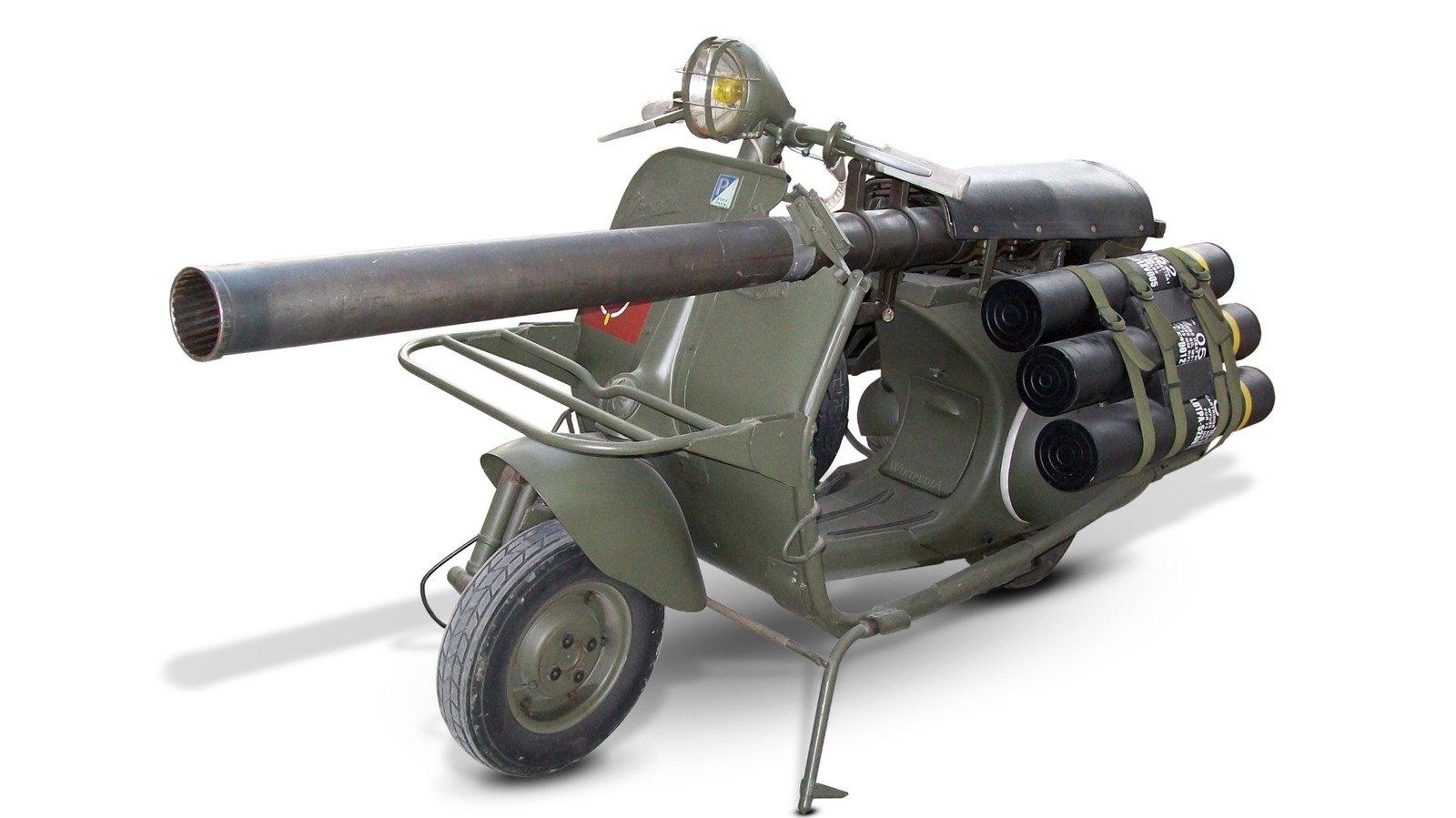
# The French Army Built a Combat Vespa for Vietnam's Jungles
The French military turned to Vespa during the First Indochina War to solve a critical mobility problem in Vietnam's dense terrain. Paratroopers needed lightweight, agile transport that could navigate jungle environments where conventional military vehicles bogged down. The iconic Italian scooter manufacturer delivered exactly that.
Vespa's appeal to military planners centered on simplicity and reliability. The company had already built scooters for civilian markets across Europe, proving the platform's durability and ease of maintenance. A militarized Vespa required minimal modification compared to designing purpose-built vehicles. The scooter's small footprint meant paratroopers could deploy it rapidly and carry it into positions where larger trucks couldn't operate. In jungle warfare, where supply lines stretched thin and mobility trumped firepower, this made tactical sense.
The French didn't just grab stock civilian scooters off dealer lots. Military engineers hardened the design with reinforced frames, raised suspension geometry for rough terrain, and modifications to handle weapons mounting. The result was a compact tactical vehicle that weighed just enough to maneuver through muddy trails and steep grades but light enough for troops to push or carry when necessary. Combat load considerations drove these choices, not comfort or road-going performance.
This wasn't unique to the French. Military forces worldwide explored motorscooters and lightweight motorcycles for rapid deployment scenarios. The U.S. military experimented with similar platforms. British and German forces tested comparable designs. The appeal transcended national boundaries. Paratroopers needed insertion mobility that separated them from larger vehicle-dependent units.
The Indochina conflict created desperation that sparked innovation. The French faced an unconventional enemy operating across difficult terrain where traditional military doctrine struggled. Counterinsurgency operations demanded different tools than conventional warfare. A Vespa could scout approaches, carry ammunition, transport wounded, or move small teams between positions far faster than soldiers on foot. Its noise signature remained relatively low compared to military trucks, offering tactical advantage in dense vegetation where enemies couldn't hear vehicles approaching.
Vespa's production capabilities also mattered. The company manufactured thousands of scooters annually, meaning the supply chain existed to support military orders without completely disrupting civilian production. Parts availability, trained mechanics who understood the platform, and established repair infrastructure made large-scale deployment feasible. This logistics advantage often determines whether equipment reaches troops reliably or sits in supply depots waiting for replacement parts.
The tactical Vespa ultimately proved a footnote in Indochina's brutal conflict. France withdrew in 1954 following the catastrophic loss at Dien Bien Phu, ending its colonial ambitions in Southeast Asia. The scooters never defined the war's outcome. They did, however, represent military thinking about asymmetrical warfare and the value of lightweight, maneuverable transport in unconventional environments.
This historical precedent influences modern military vehicle design. Contemporary forces still deploy ATVs, motorcycles, and ultra-lightweight tactical vehicles in irregular warfare scenarios. The principle remains unchanged: sometimes the smallest vehicle accomplishes missions that massive trucks cannot. Vespa's transformation from street transport to jungle warfare machine demonstrated how civilian engineering can solve military problems when conventional approaches fail.