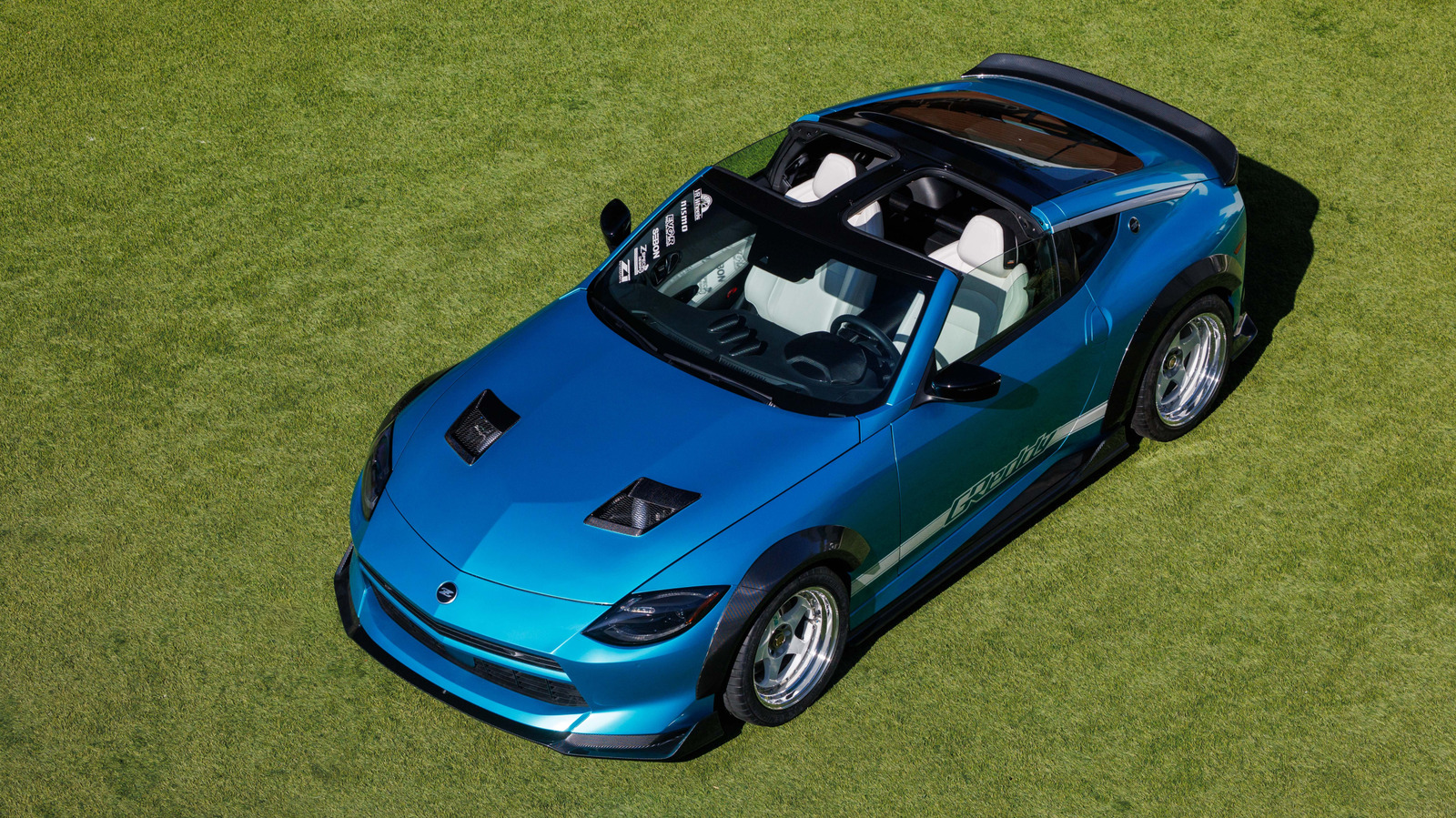
Nissan has unveiled the Z Kaze concept, a removable T-top variant of the new Z that addresses one of the most glaring omissions from the modern sports car's debut lineup. The concept demonstrates that a targa-style roof configuration could move from design study to production without major engineering compromises.
The Z returned to market in 2023 after a thirteen-year hiatus, powered by a twin-turbocharged 3.0-liter V6 producing 400 horsepower and 350 pound-feet of torque. Nissan offered the car with a six-speed manual or nine-speed automatic, positioning it as an affordable alternative to the Chevrolet Corvette and Porsche 911. What it did not offer was a convertible or removable-roof variant, a notable gap given the original Z's legacy of various open-air configurations throughout its fifty-year production run.
The Z Kaze concept fills that void with a practical T-top design. The removable roof panel above the driver and passenger seats, combined with a fixed structural spine running down the center, provides open-air driving without fully sacrificing rigidity or weather protection. The two-piece removal system appears straightforward enough for real-world production, with manageable weight and simple storage solutions.
The design matters because convertible and targa sports cars command premium pricing while maintaining strong margins for manufacturers. Porsche's 911 Cabriolet and Targa variants sell at significant premiums over the coupe. BMW's M440i xDrive leverages its convertible option to justify higher pricing in the compact luxury segment. A Z Kaze production version would likely sit $8,000 to $12,000 above the current Z's $39,790 starting price.
T-top designs also sidestep some engineering headaches of full convertibles. Convertibles require extensive chassis bracing, reinforced door frames, and complex hydraulic systems. T-tops use the existing structure and add removable panels, reducing development cost and complexity. Nissan's platform, already proven in the current Z, appears structurally sound for this application.
The timing aligns with Nissan's broader product strategy. The company faces intense pressure from luxury competitors and American manufacturers pushing increasingly powerful turbocharged engines. The Z currently undercuts the Corvette on price but trails in raw performance metrics. An open-air variant would differentiate the Z in a crowded two-seater market without requiring all-new powertrains or platform development.
Concept cars often preview production intent at Japanese manufacturers. Nissan has shown real commitment to the Z's longevity, already planning generation updates and performance variants. A T-top production version would leverage existing tooling and supply chains while addressing customer feedback about the original Z's open-air legacy.
The real question is timing and market demand. Nissan must balance tooling investment against addressable market size. A Z Kaze production version would cannibalize some coupe sales while capturing buyers previously lost to BMW Z4 and Porsche 911 models. At Nissan's current production scale for the Z, that calculus likely tilts positive. Expect an announcement within eighteen months if internal feasibility studies confirm structural and manufacturing viability.