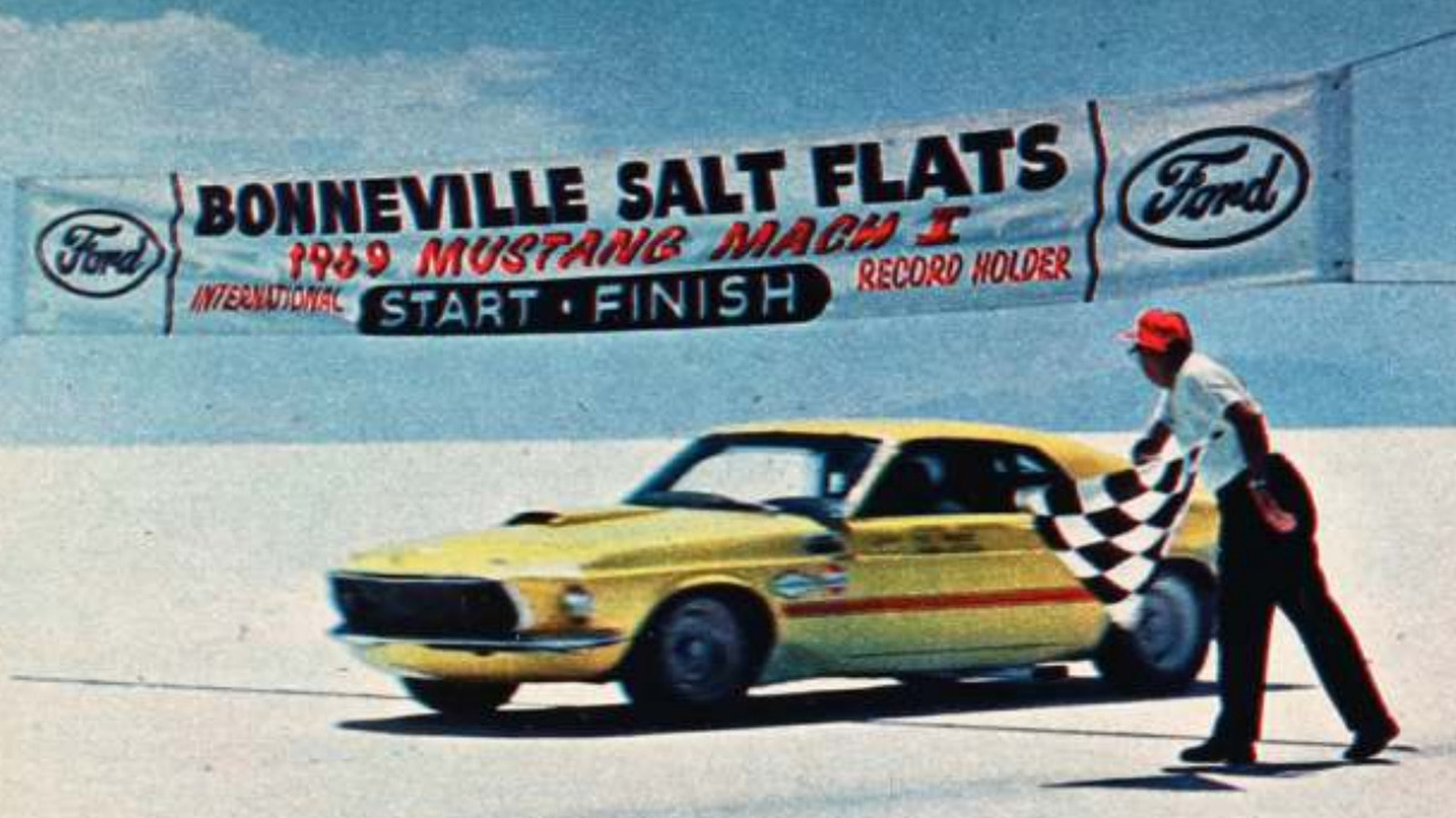
Mickey Thompson remains one of the most prolific land-speed record holders in automotive history. His assault on Bonneville Salt Flats records using a 1969 Ford Mustang Mach 1 demonstrates the intersection of American muscle car engineering, driver skill, and purpose-built competition machinery that defined the late 1960s racing era.
Thompson's record-setting campaign at Bonneville in 1968 netted him 295 official speed records. This staggering number reflects the salt flats' classification system, which breaks records into multiple categories based on engine displacement, vehicle weight, fuel type, and distance traveled. A single run that would appear as one record in casual conversation actually represents dozens when parsed through FIA and SCTA regulations. Thompson exploited this by running his Mustang across virtually every applicable category, accumulating records at an industrial pace.
The 1969 Mustang Mach 1 served as Thompson's platform. Ford's muscle car had just debuted its redesigned body for the 1969 model year, featuring more aggressive styling and a broader engine lineup. For Thompson's assault, the Mustang received extensive internal modifications beyond the factory's wildest intentions. Race-prepped engines, aerodynamic refinements, and lightweight component substitutions transformed a production car into a legitimate land-speed weapon while maintaining enough mechanical continuity to satisfy Bonneville's regulations for various record classes.
Thompson's record-breaking methodology relied on exploiting technicalities within a rational system. Bonneville's categories exist to ensure fair comparison between vehicles of different specifications. By running different engine configurations, fuel mixtures, and gearing ratios, Thompson could generate a new record in nearly every combination. This approach was entirely legal and reflected deep understanding of both his machine and the rule book.
The broader context matters here. Land-speed racing at Bonneville peaked in popularity during the 1960s. Television coverage brought salt flats competition to American living rooms. Automotive manufacturers viewed Bonneville participation as affordable marketing compared to other racing venues. Thompson's success elevated the venue's prestige and proved that American iron could dominate at extreme speeds.
Thompson himself represented a rare breed of racing entrepreneur. He designed and built race cars, drove them competitively, and ran his own racing operation. His work at Bonneville spanned decades and generated some 600 official records across multiple vehicles and time periods. The 1968 Mustang campaign represented a peak moment in this trajectory.
The Mustang records also reflect how comprehensively Ford had engineered its muscle car platform by the late 1960s. The model offered multiple displacement options, from 200-cubic-inch inline sixes up to 427-cubic-inch big blocks in some configurations. This flexibility meant Thompson could field differently-sized engines within the same chassis, each generating valid records in its respective category.
Today, Thompson's Bonneville records have been broken many times over by purpose-built streamliners powered by turbocharged engines and jet propulsion. Modern vehicles post single records rather than Thompson's shotgun approach to multiple categories. Yet the 1969 Mustang Mach 1 campaign endures as a snapshot of an era when stock-based muscle cars could genuinely be transformed into competitive land-speed machines with mechanical sophistication rather than exotic technology. Thompson's 295 records represent a record-setting philosophy that no longer exists in organized racing, making the achievement historically singular.