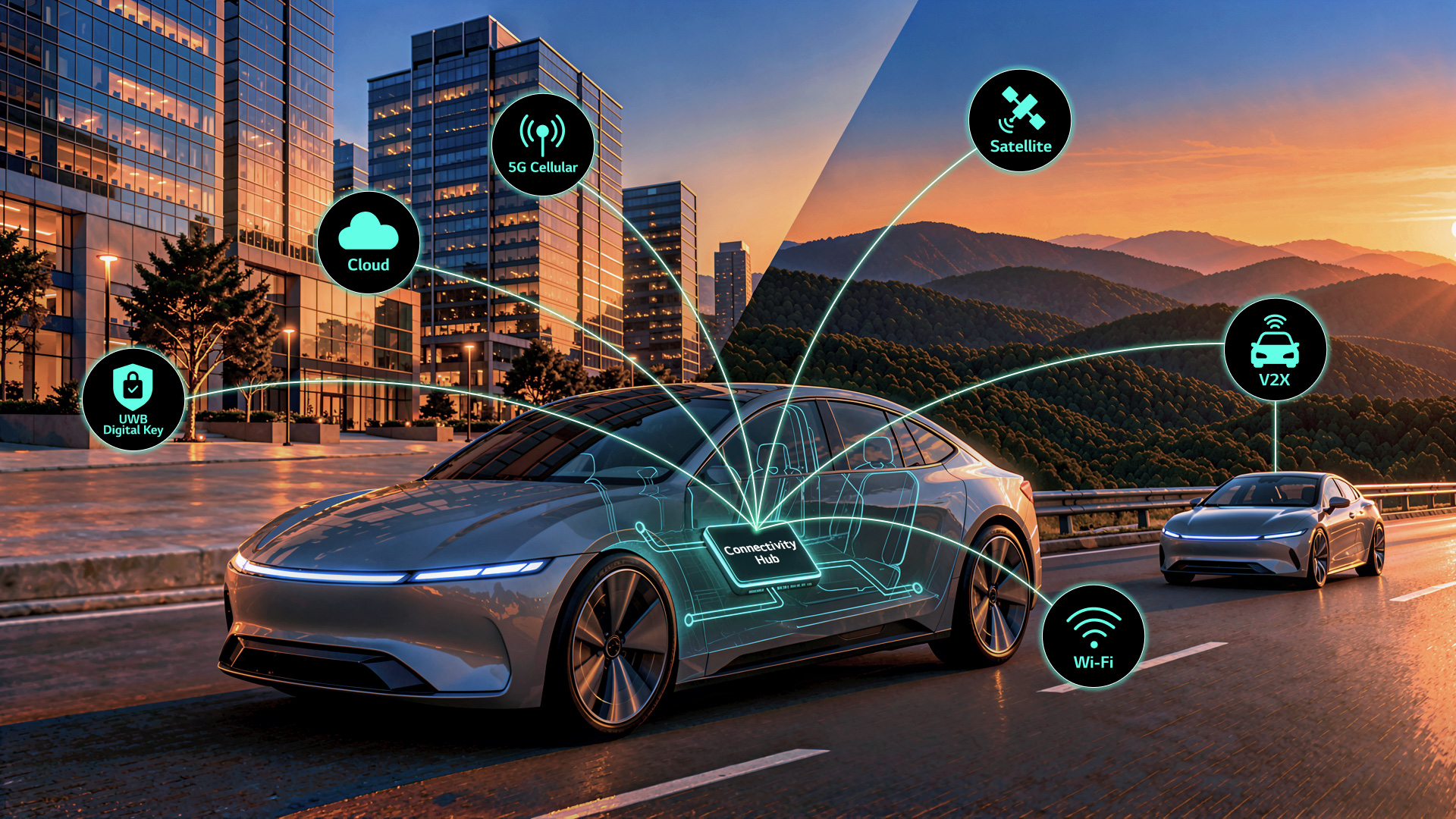
LG Electronics' Hajong Sung discusses how smart telematics consolidates antennas, communication modules, and related functions into integrated connectivity hubs to manage the expanding range of wireless technologies vehicles require, from cellular and satellite communications to vehicle-to-everything (V2X) connectivity and digital keys.
Integrating antennas and communication modules into a single unit reduces radio frequency cabling, wiring complexity, packaging volume, weight, and overall cost while minimizing cable losses and improving signal quality. However, integration creates engineering challenges. Multiple radios operating in proximity increase the risk of RF coexistence issues, intermodulation, and receiver desensitization. Thermal management becomes more demanding because high-power communication devices and antennas share a confined enclosure.
Software-defined antenna (SDA) technology provides flexibility within physical limits. Today SDAs handle simple frequency tuning and are expected to move toward coordinated control of frequency, impedance, and radiation pattern. This gives automakers four areas of flexibility. Vehicle-specific optimization allows software-based compensation for differences in antenna mounting positions and metal body structures across sedans, SUVs, and trucks. Supply chain efficiency lets automakers use a common hardware module across markets and vehicle types, with software configuration supporting applicable regional frequency bands. Network expansion through antenna sharing allows terrestrial and non-terrestrial antennas to combine into one unit, with software switching between them seamlessly. Real-time adaptation to driving environment enables the vehicle to optimize antenna radiation characteristics as it moves through urban areas, tunnels, or changes direction.
Software adjustments remain bounded by hardware. Tunable components have minimum and maximum capacitance limits. Switching between two linear polarizations or two circular polarizations is achievable, but switching between linear and circular in one antenna remains technically difficult. Tunable components also constrain antenna design by requiring engineers to minimize insertion loss and keep designs within maximum input voltage limits.
Combining telematics and digital key functions within a single connectivity hub reduces electronic control unit count, simplifies vehicle architecture, and decreases wiring complexity. However, security must be preserved. Sung states: "Even when telematics and digital key share hardware resources, security-critical vehicle access functions should remain logically isolated."