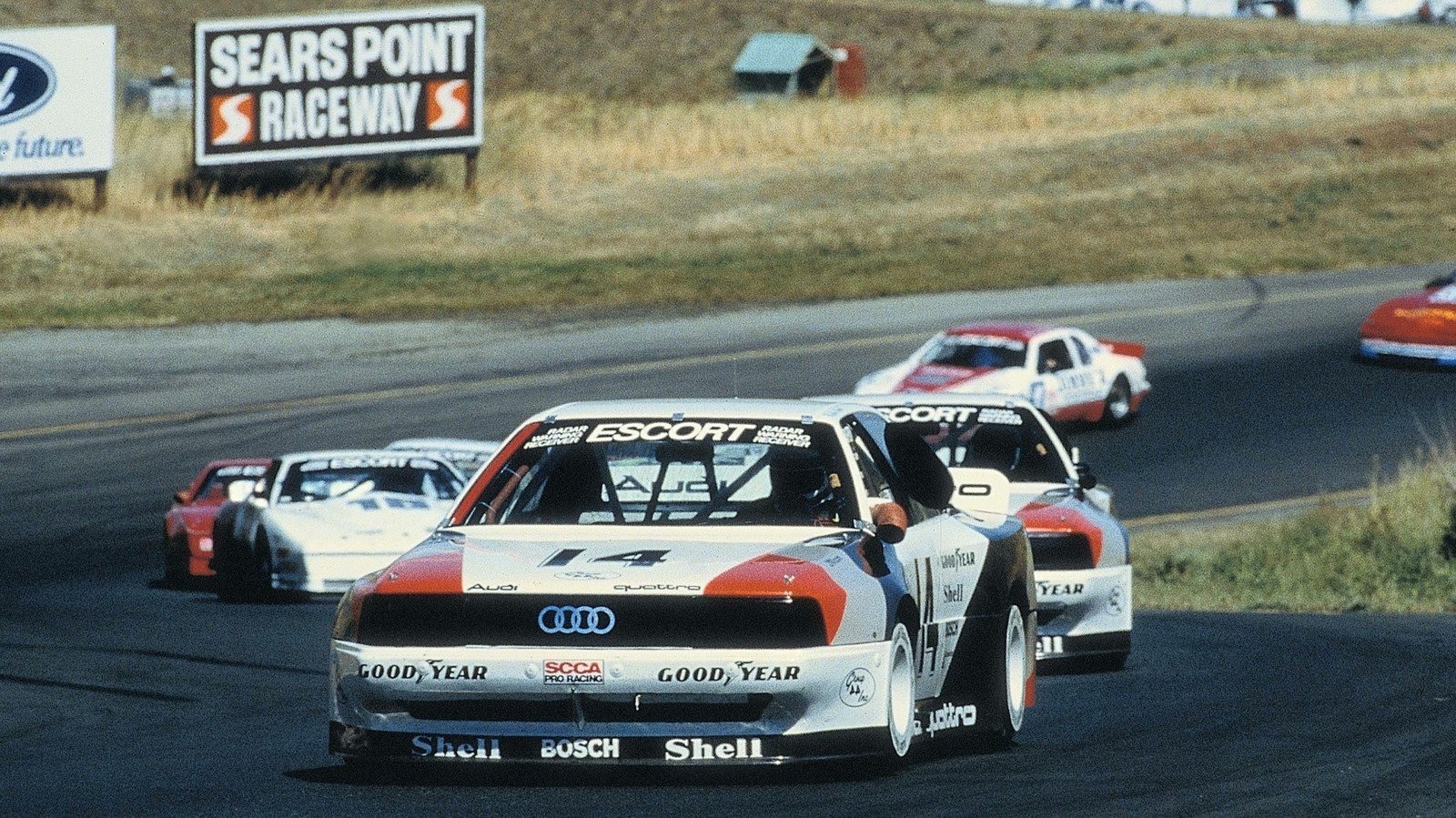
# How Audi's Underdog 2.1-Liter Engine Conquered Trans-Am in 1988
Audi entered the 1988 SCCA Trans-Am championship with a decided disadvantage. While competitors fielded naturally aspirated V8 engines displacing 5.0 liters or larger, Audi's 2.1-liter turbocharged four-cylinder mill gave away nearly 3.0 liters of displacement to the field. Yet the German manufacturer achieved near-total dominance in that season, fundamentally challenging how the American racing community thought about power and engineering.
The Trans-Am series in 1988 represented the pinnacle of American road racing. The championship attracted factory support from Chevrolet, Jaguar, and Porsche, among others. These manufacturers typically relied on large-displacement, high-horsepower engines refined over decades of domestic racing tradition. Audi's arrival with a compact turbocharged power plant struck many as a gamble, if not an outright mistake.
The 2.1-liter engine produced around 600 horsepower in race trim, achieved through aggressive turbocharging and tuning. What made this remarkable was not just the raw output but the torque delivery and consistency. Turbocharging provided instant power availability throughout the rpm range, something naturally aspirated V8s struggled to match on road courses demanding constant throttle modulation. Audi's engineers had perfected boost management and intercooler technology, delivering power precisely when drivers needed it most.
Audi's chassis engineering proved equally sophisticated. The car featured all-wheel drive, a technology nearly unheard of in Trans-Am at the time. This gave Audi's driver immediate traction advantages exiting corners, particularly on tracks like Road America and Watkins Glen where grip transfers directly to lap time. While front-wheel-drive competitors and rear-wheel-drive rivals fought wheelspin, Audi simply accelerated. Combined with Audi's refined suspension geometry and weight distribution, the all-wheel-drive system delivered a tangible on-track advantage competitors could not match.
The 1988 season saw Audi drivers claim multiple victories and podium finishes, sometimes winning by decisive margins. Jaguar and Chevrolet pushed hard, but they remained fundamentally outgunned by the combination of turbocharged efficiency and all-wheel-drive traction. Audi's smaller engine displacement became irrelevant. What mattered was horsepower-per-liter efficiency, power delivery, and mechanical grip. Audi excelled in all three categories.
The series' engine capacity rules had no minimum displacement requirement at that time, only maximum limits. Audi exploited this loophole by proving that intelligent engineering could defeat raw size. The 2.1-liter's efficiency meant lower fuel consumption, reducing pit-stop frequency on longer races. The power plant's reliability, built to Audi's exacting standards, minimized mechanical failures that plagued some competitors.
This 1988 Trans-Am campaign represented a watershed moment in American motorsports. Audi proved that European engineering philosophy, particularly forced induction and all-wheel-drive technology, could dominate traditional American racing series. The dominance wasn't luck or gimmickry. It reflected years of Audi's quattro all-wheel-drive development and turbo expertise refined in Group B racing and road car development.
The impact echoed through racing for years. Subsequent Trans-Am regulations tightened to prevent similar technological dominance from non-traditional manufacturers, and other series began reconsidering four-cylinder turbo platforms as legitimate competitors to large-displacement engines. Audi's 2.1-liter four-cylinder had rewritten the rulebook. Size truly did not matter when engineering precision met strategic rule exploitation.