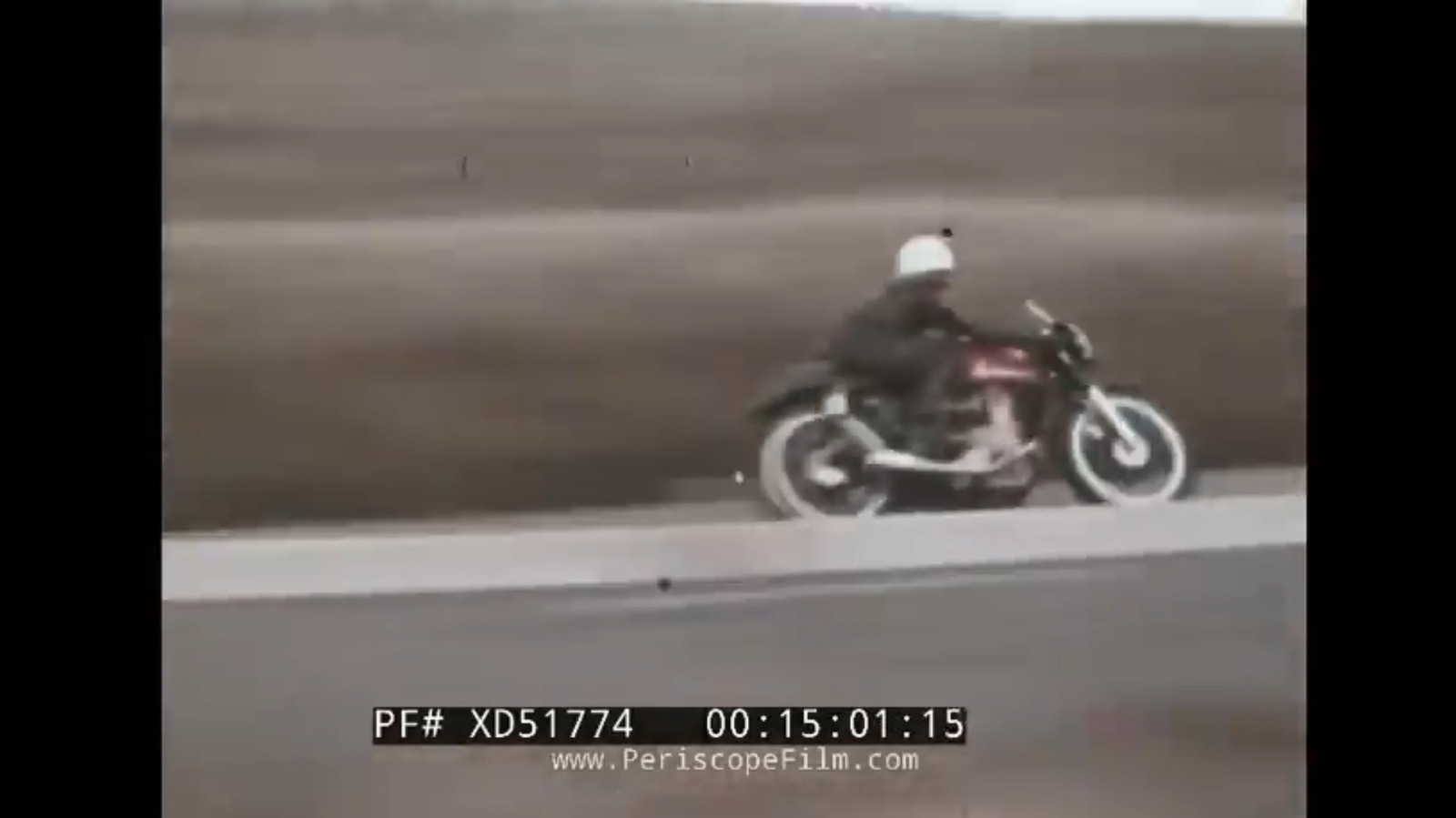
# Geoff Duke's 1960s Motorcycle Masterclass Offers Timeless Racing Wisdom Now Streaming
Geoff Duke, the six-time Isle of Man TT winner and one of motorcycle racing's most dominant figures, distilled his racing philosophy into a 1960s instructional film now available to stream. The legendary British racer emphasizes a principle that separates champions from also-rans: understanding the precise limits of both rider and machine.
Duke won the Isle of Man TT six times between 1951 and 1955, an era when the course remained brutally unforgiving and safety equipment was minimal. His ability to extract maximum performance while maintaining control made him a standout in an era when motorcycle racing demanded equal parts bravery and mechanical sympathy. That balance between aggression and restraint forms the core of his instructional approach.
The film captures Duke at the height of his influence, before retirement from competition ended his on-track career. Rather than simply demonstrating speed, Duke focuses on the deliberate process of learning a circuit, reading weather conditions, and recognizing when pushing harder yields diminishing returns. This methodical approach contradicts the romantic notion of fearless racers charging recklessly toward victory. Duke's championship record proves that calculated precision outperforms blind aggression.
His most critical teaching point centers on knowing limitations. Too many riders, Duke suggests, attempt to ride beyond their capabilities or fail to respect what their machines can actually deliver. A motorcycle has finite grip, finite braking performance, and finite acceleration. A rider has finite reflexes, finite courage, and finite skill. Success arrives when those human and mechanical constraints align with the demands of the circuit and conditions.
This philosophy remains entirely relevant to modern motorcycle racing. Contemporary MotoGP and World Superbike competitors spend enormous resources on simulation, data analysis, and feedback loops specifically to understand their own performance envelope and their machine's capabilities at every track. Duke preached the same gospel without telemetry or computers.
The Isle of Man TT remains the only motorcycle racing series where Duke's hard-earned principles receive constant validation. Modern riders on that course still die when they overestimate their abilities or their machines' grip. The TT punishes overconfidence with finality. Duke understood this viscerally. His systematic approach to speed reduced risk while maximizing performance, a combination that kept him alive and winning in an era when many of his competitors perished.
Streaming access to Duke's instructional material offers contemporary motorcycle enthusiasts and racers something genuinely rare: direct instruction from a figure who redefined what was possible on two wheels. His technical tips cover body positioning, throttle control, and line selection. His strategic advice addresses pacing, fuel management, and mental preparation. But the emotional core remains that single principle about knowing limits.
For casual viewers, the film provides historical context on racing motorcycle development and track conditions in the early 1960s. For serious riders and racers, it offers a master class from someone who proved repeatedly that championships come from riding smart, not just fast. That message transcends decades of technological change.