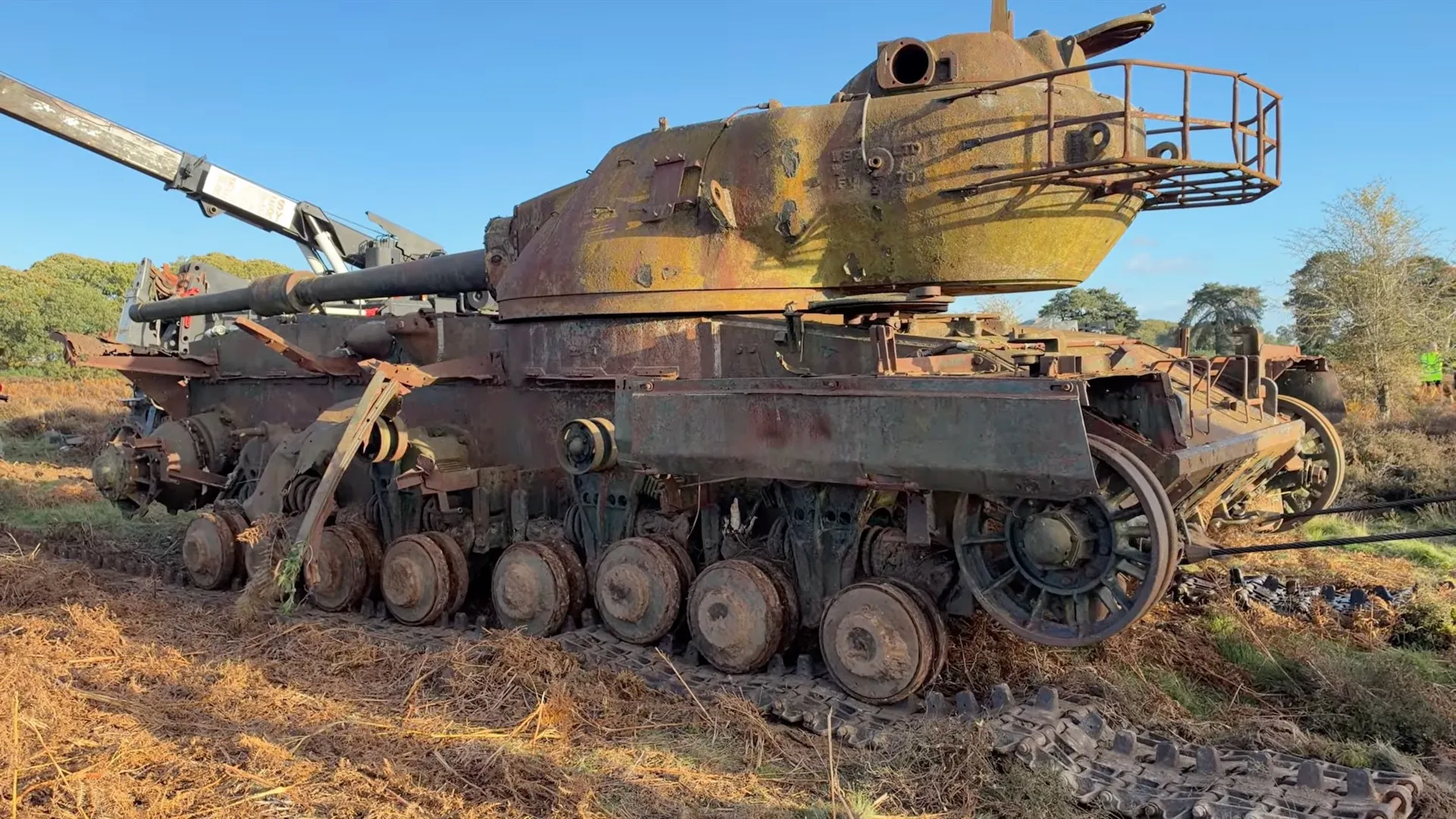
Joe Hewes and staff from The Tank Museum recovered a British Conqueror tank from a derelict Ministry of Defence gunnery range in the United Kingdom. The tank weighed approximately 65 tons when new, though this particular example was missing its engine, transmission, turret, and main gun. It sat in a swampy live-fire area where unexploded ordnance lay potentially buried below the surface.
The museum is restoring the Conqueror by sourcing replacement turret and gun components from the derelict tank. The critical obstacle was that the vehicle lacked tracks, which distribute weight and prevent tanks from sinking into soft ground. Without tracks, towing would have caused the massive vehicle to dig in dangerously.
The Ministry of Defence would not permit recovery unless the tracks were reinstalled first. Hewes brought in two military-grade Foden heavy recovery trucks, once used by the British Army, to jack the Conqueror in place while replacement tracks were fitted. An Oshkosh M1070 semi-truck, standard U.S. military equipment for transporting tanks, then winched the Conqueror onto its new tracks and hauled it off-site on a trailer.
The Conqueror represents a transitional design between the Centurion and Chieftain tanks, developed in the early Cold War as Britain's response to the Soviet IS-3. Though it proved unsuccessful operationally, military historians consider the vehicle important to the complete story of British tank development.