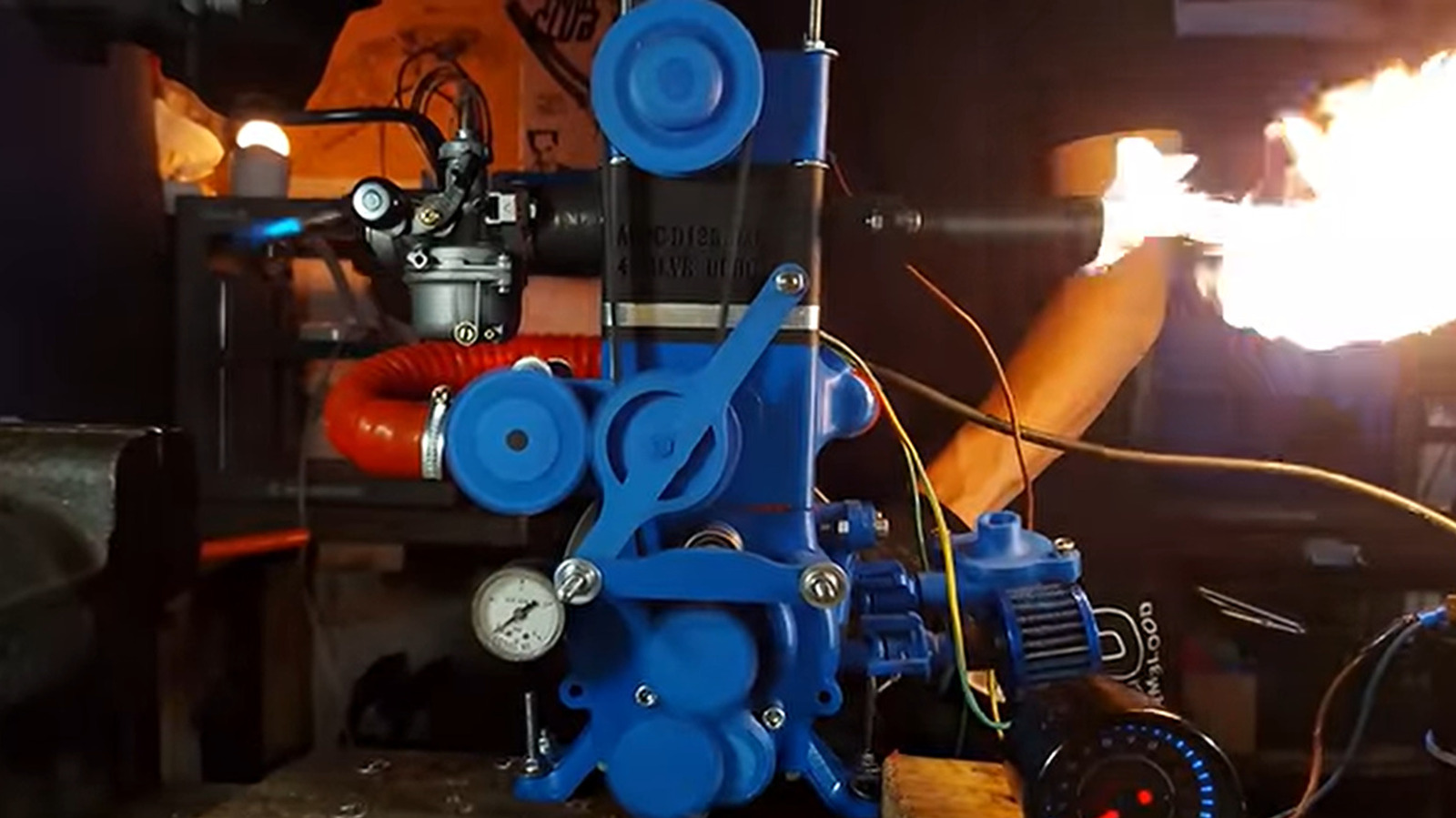
YouTuber and mad scientist Alexander's Laboratory recently built and ran a pair of 3D-printed plastic engines—a single-cylinder and a parallel twin—and the results tell us something important: plastic engines aren't coming to your driveway anytime soon, but the hybrid approach might actually be onto something. The fundamental problem is basic physics. ABS has a melting point of around 440 degrees Fahrenheit, while most available PLAs melt at 340-ish degrees. Meanwhile, the combustion chamber in a running engine can get up to 2,500 degrees during the peak of the power stroke. Plastic simply doesn't stand a chance under those conditions, which is why most engines are crafted from cast iron or aluminum.
Alexander's approach was smart: he strategically used machined steel for the cylinder walls and the combustion chamber surface, while keeping the crankshaft metal as well. The piston surfaces are metal, but pretty much everything else comes straight off the printer. We've already seen what happens when you try to use a 3D-printed cylinder head—the results aren't pretty. There are certainly some engines that have made extensive use of plastic, including the Torlon-based engines from Polimotor Research in the 1970s and 80s, but there isn't a high-enough-heat plastic to manage combustion chamber heat spikes, so a blend of metal and plastic is necessary.
The single-cylinder experiment revealed the challenges ahead. Alexander initially struggled with sparks and grounding issues—it's harder to get everything to ground out properly when the engine is non-conductive. Once running, it sounded like a normal single-cylinder four-stroke engine, the kind you might find in a lawnmower or go-kart. But when he piled on the throttle, the carbon-reinforced plastic connecting rod gave up and shot through the side of the plastic block. The twin-cylinder engine, however, tells a different story. Using some beefed-up components, more metal, and better heat management, this little 250-cc twin seemed to run like a standard small motorcycle or scooter engine would, and it just kept chugging.
The real promise here isn't that we're abandoning metal for plastic—it's that we can strategically combine them. Recent research indicates swapping from a metal component to a 3D-printed plastic replacement cuts weight by 30% and costs by 15%. With enough research, you could add structural lattice inside some areas to make it even lighter or allow better coolant flow to critical heat spots. But we need to be realistic about where plastic belongs: the combustion chamber, cylinder head, pistons, crankshaft, valves, valve springs, and bearing systems all need to stay metal for now.
Maybe it's time to start developing open-source plastic engines that can run with just a few off-the-shelf components. But let's not fool ourselves into thinking we're eliminating metal from engine design—we're just getting smarter about where we use it.