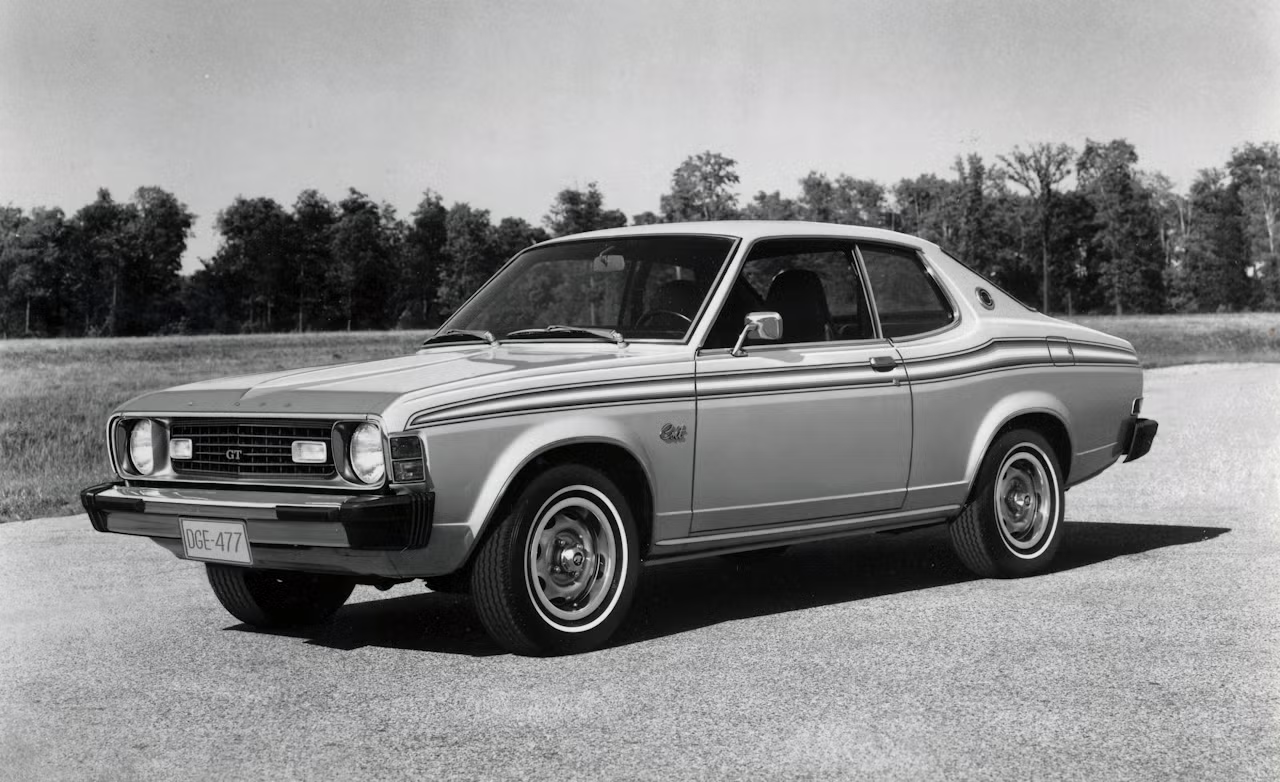
The 1976 Dodge Colt GT, powered by Mitsubishi's Astron 80 engine with its ingenious silent-shaft technology, represents far more than a clever engineering solution to engine noise. It stands as a damning indictment of Detroit's retreat from innovation during an era when bold thinking should define the American automotive response to crisis. While most of the automotive world appears to be slowly sinking into a legislative morass, Japan Incorporated continues to send creative solutions to intricate problems. The question isn't whether the Colt's refinements are impressive—they clearly are—but rather why American manufacturers have ceded this territory so completely.
Consider what Mitsubishi has delivered in this modest compact. The two-liter engine produces 96 bhp with an aluminum cylinder head featuring hemispherical combustion chambers and cross-flow porting. Add the silent shafts, and suddenly a four-cylinder sounds so refined at 6000 rpm that drivers might mistake it for a six-cylinder engine. Pair this with a five-speed gearbox featuring overdrive-top-gear design, and the Colt cruises at 60 mph at just 2800 rpm—so quietly that at 70 mph, the sound-level meter says the engine cannot be heard. This isn't incremental improvement; it's comprehensive thinking applied to the entire driving experience.
The efficiency metrics are equally telling. In Car and Driver's testing from the April 1976 issue, the Colt achieved 23.0 mpg in city driving and 25.5 mpg on the highway, all while remaining happy with cheaper leaded fuel. Yes, these numbers fall short of economy champions like the 1976 VW Rabbit by roughly three mpg, but the Colt's capabilities extend far beyond fuel consumption. It offers hardtops, four-door sedans, and woodgrain wagons with enough standard equipment—excellent ventilation, reclining seats, locking gas lid, electric rear window defogger, and an adjustable steering column—that the competition should wonder how to compete. You can acquire a GT hardtop with silent shafts and five-speed transmission for less than $4000.
Yet the Colt isn't without flaws. The rear suspension, apparently starved of development resources to fund the silent-shaft technology, exhibits poor handling characteristics. The rear axle winds up the two-leaf springs excessively during aggressive acceleration, and the front tires hunt for pavement grooves during cornering. The steering proves too slow to manage the heavy understeer that inevitably sets in. These aren't minor complaints—they reveal that even Mitsubishi's thoughtful engineering has limits when cost pressures apply.
The real lesson here transcends one Japanese compact car. Detroit retreats and retrenches, shedding engines and powertrain choices by the numbers, while Japan fortifies most models with five speeds and breaks new ground with four-wheel-drive subcompacts. If an answer to our next crisis looms, there's little doubt from whence it will come. American manufacturers must recognize that buying cars they cannot justify building themselves—as Chrysler does with the Colt—only accelerates their technological obsolescence. Japan's mastery of small cars, proven through innovations like silent shafts and integrated antenna technology, exposes what Detroit has preferred to ignore: that necessity breeds excellence, and complacency breeds irrelevance.