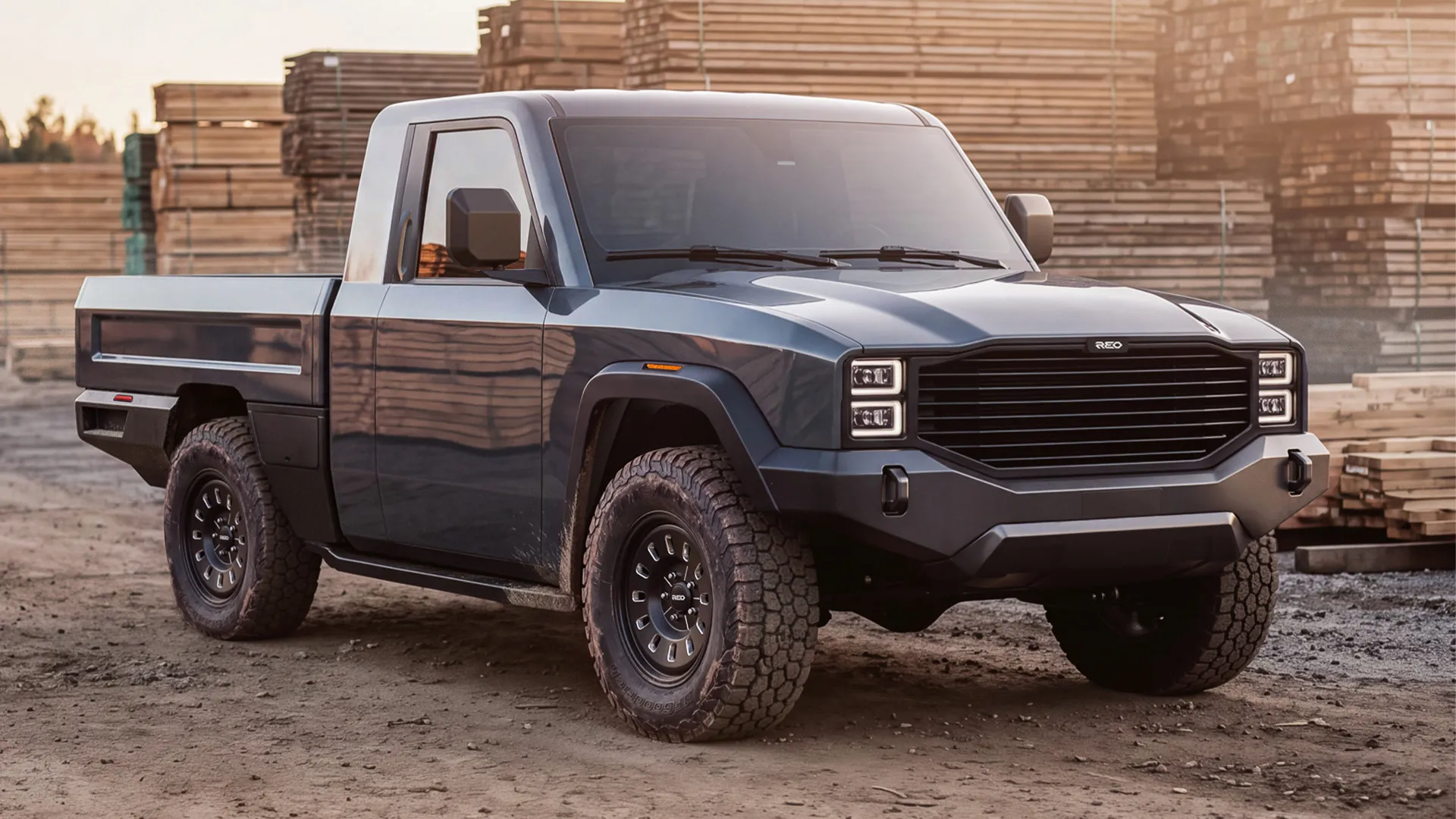
The small truck renaissance is finally delivering what buyers actually want, and REO's approach to the segment might be the most honest yet. While Ford and Slate are both pushing affordable electric pickups in the coming years, REO is betting that there's a substantial market for buyers who prefer naturally aspirated four-cylinder engines, manual transmissions, and solid front axles. If the company can execute on its promises, it won't just compete with those two—it could fundamentally change how the industry thinks about simplicity.
What makes REO's vision genuinely compelling is the deliberate refusal to overcomplicate. The Runabout lineup—comprising the T4X work truck, T4C crew cab, and S4C family SUV—will all share the same ladder frame, engines, mechanical 4×4 systems, and transmission options. CEO and Founder Zach De Bernardi has stated his preference for a six-speed automatic, though the company is still evaluating transmission specifics with suppliers. Manual versions will cost about $1,500 less than automatics. This isn't trendy minimalism; it's pragmatism designed around the goal of creating a 500,000-mile vehicle. Fewer moving parts and fewer computers achieve what most modern trucks cannot: genuine longevity.
Frank Stephenson Design's involvement adds credibility to the exterior execution. The designer behind the reborn Mini and McLaren P1 has styled the Runabout's biomimicry-inspired design—modeled on a bison—with remarkable foresight. The firm ensured the grille could cool whatever engine eventually powers these trucks and even accounted for future engine swaps that owners might pursue. These are the details that separate a startup with vision from one destined to fail. The dimensions are equally sensible: the T4X offers a 79.1-inch bed measuring 70.6 inches wide between sidewalls, while the T4C crew cab delivers a 54.1-inch bed, practically matching the Ford Maverick's 54.4 inches.
REO's business model is equally refreshing. The company refuses subscription-based features and promises that trouble codes will be readable by $30 parts store scanners. This philosophy reflects De Bernardi's understanding that buyers want to own, fix, and keep their vehicles—a stark contrast to the modern auto industry's software-locked approach. The aggressive timeline—pilot builds in 2027, order book in 2028, and first deliveries in late 2028 to 2029—paired with the $21,500 starting price for the T4X will be difficult to achieve. Yet De Bernardi's confidence that simplicity enables speed is not without merit.
REO still faces significant hurdles. Securing powertrain suppliers, finding or repurposing a facility in the Dallas-Fort Worth area, and hitting that aggressive timeline while maintaining American manufacturing are formidable challenges. But unlike many truck startups, REO isn't chasing futurism—it's resurrecting what worked in the 1980s and '90s while applying contemporary design thinking. If the company can deliver a genuinely repairable, affordable truck that lasts half a million miles, the market has already shown it's ready to buy.