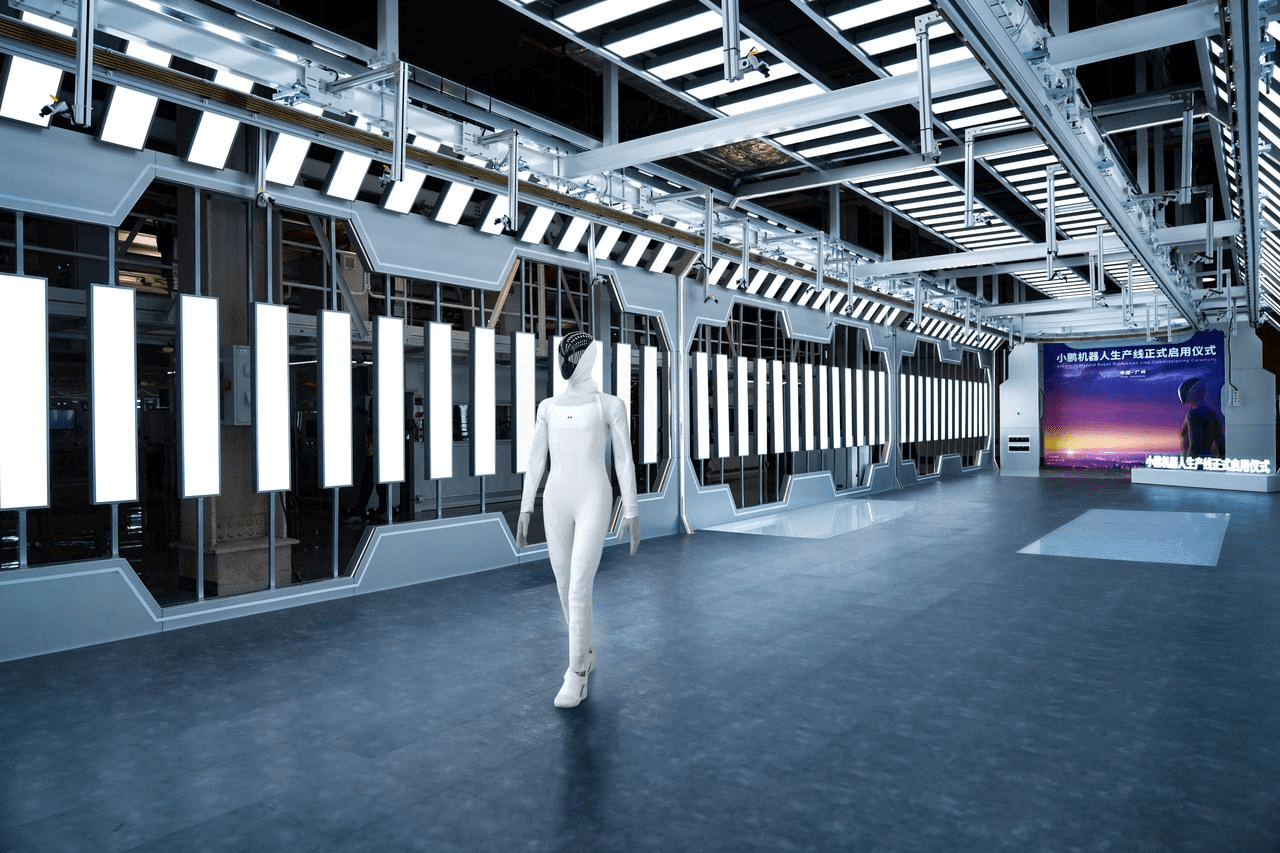
XPeng has powered up the first automated production line for humanoid robots, marking a decisive competitive move against Tesla's stalled Optimus development. The Chinese automaker's IRON robot walked off the assembly line under its own power, demonstrating that the company has moved beyond prototype stages into actual manufacturing operations.
The production facility runs with over 80% automation across core processes, a level of manufacturing sophistication that separates genuine production capability from laboratory demonstrations. XPeng targets full mass production by the end of 2026, establishing a concrete timeline that contrasts sharply with Tesla's ongoing delays on Optimus. Elon Musk's humanoid robot initiative has struggled to meet multiple production targets, with Tesla repeatedly pushing back timelines while facing engineering challenges around dexterity, durability, and cost efficiency.
This move by XPeng reflects the broader reality of the humanoid robotics race. While Tesla dominates conversation around future robot adoption, the company has not yet shipped production units to customers or deployed meaningful volumes in real-world operations. XPeng, by contrast, has already demonstrated operational capability through its IRON line and now commits to scaling that production within months rather than years.
The IRON robot targets industrial and commercial applications, positioning itself as a practical solution for repetitive tasks, manufacturing support, and logistics operations. XPeng has previously outlined use cases in factory automation and service roles, areas where humanoid robots can directly replace human labor and reduce operational costs. The company's automotive manufacturing expertise provides natural advantages in robotics production, factory automation, and supply chain management that Tesla must build from scratch.
XPeng's announcement also signals confidence in consumer and enterprise demand. Setting an aggressive mass production target indicates the company has already secured customer commitments or internal demand projections sufficient to justify the capital investment in automated production infrastructure. Manufacturing a humanoid robot at scale requires precision engineering across multiple systems including actuators, sensors, AI algorithms, and battery technology. XPeng's willingness to commit resources to an 80%-automated production line suggests engineering validation is largely complete.
Tesla's Optimus challenges stem partly from the company's relentless pursuit of cost reduction and autonomous operation. Musk has stated the robot must eventually cost less than a new car to justify mass adoption. That engineering constraint drives complexity, as the system must perform diverse tasks with minimal human intervention while operating profitably at lower price points. XPeng may be pursuing a different strategy, targeting higher margins on a narrower range of commercial applications rather than chasing consumer ubiquity.
The competitive implications extend beyond robotics into AI and automation investment. Companies choosing between robotic solutions will increasingly favor vendors with proven production capability and delivery timelines. XPeng's early manufacturing win establishes credibility in an emerging market where execution matters more than promises.
Tesla retains advantages in battery technology, software sophistication, and brand recognition. However, shipping hardware matters in robotics more than in software. Tesla's delays have given XPeng, Boston Dynamics, and other competitors runway to mature their platforms and secure early customer relationships. By 2026, the market will judge humanoid robots on actual deployment data, cost performance, and reliability metrics rather than concept renderings or stage demonstrations.
XPeng's IRON production line announcement represents a maturation inflection point in the robotics industry. The hardware is real. The factories are running. The competitive clock is ticking for Tesla to translate Optimus from prototype to production, a challenge that has proven far harder than the company anticipated.