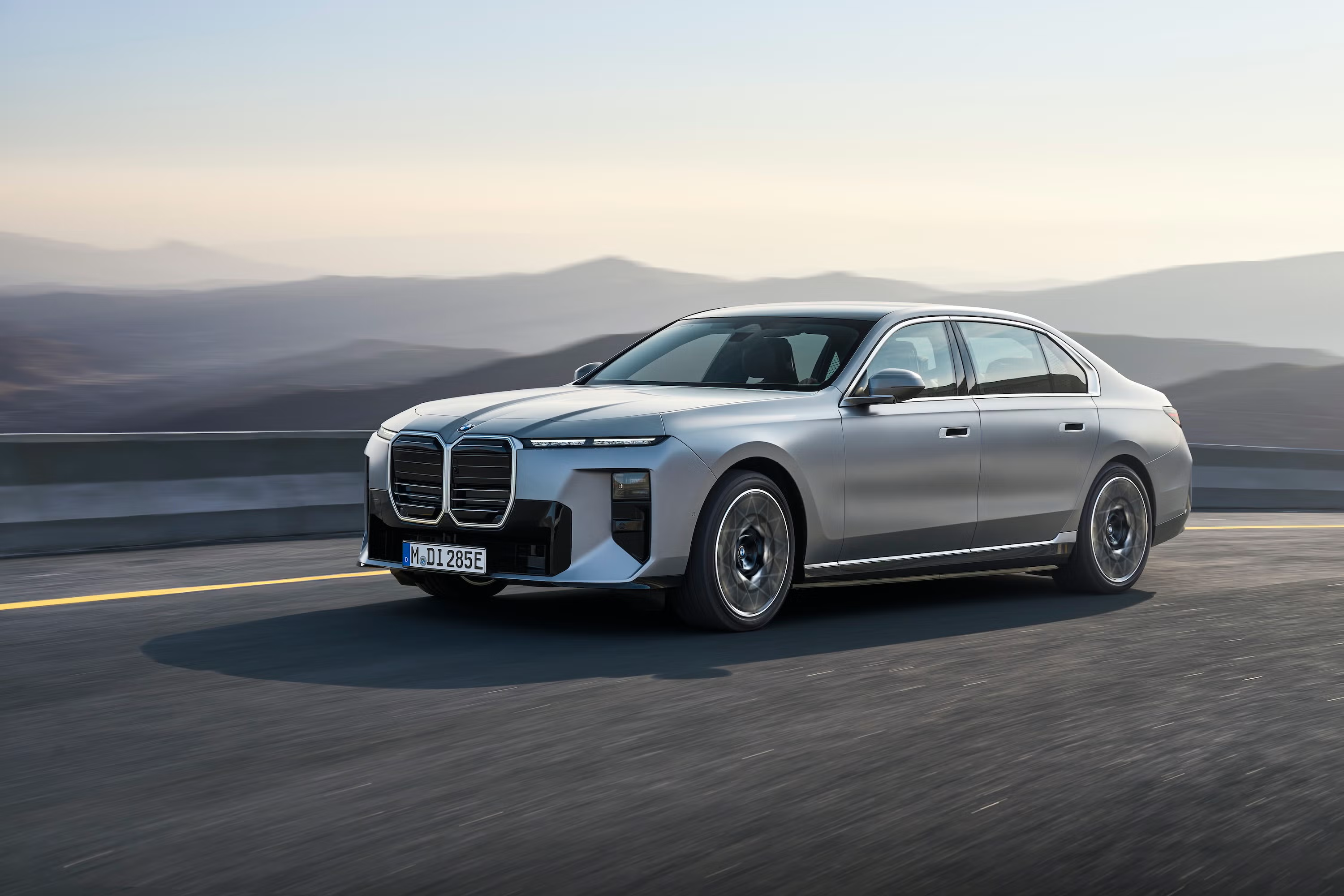
# BMW's All-Electric i7 Targets Luxury EV Leadership in 2027
BMW confirms the next-generation i7 will arrive in 2027 as a fully electric sedan, marking a decisive shift in the company's luxury vehicle strategy. The all-new model replaces the current i7 lineup, which currently relies on hybrid powertrain options alongside its electric variant.
The 2027 i7 represents BMW's commitment to competing directly with the Mercedes-Benz EQE and Tesla Model S in the premium electric sedan segment. This generation transition eliminates gas and plug-in hybrid variants, betting entirely on battery power for buyers seeking top-tier German luxury with zero tailpipe emissions.
BMW has not released detailed powertrain specifications for the 2027 model year, but industry expectations center on the company's latest battery architecture. The current i7 xDrive60 produces 526 horsepower and 553 pound-feet of torque from dual motors, achieving 60 mph in 4.6 seconds. The new generation will almost certainly exceed these figures, particularly given advances in BMW's iX M60 platform and ongoing battery energy density improvements across the industry.
Pricing details remain unconfirmed, though the current i7 xDrive60 starts around $120,000 before options. Luxury EV pricing typically increases with each generation, and BMW's trajectory suggests the 2027 model could command $125,000 to $135,000 at launch. This positions the new i7 between the EQE sedan and Model S, where BMW expects strong uptake among high-net-worth buyers prioritizing heritage brand prestige.
The design language will follow BMW's latest design vocabulary, incorporating slimmer headlights, a refined kidney grille treatment, and an updated interior infotainment system. Range expectations lean toward 300 to 400 miles on a full charge, placing it competitive with the EQE's capabilities and above the Model S Long Range's practical range in real-world conditions.
This timing aligns with BMW's broader electrification roadmap. The company targets 50 percent electric vehicle sales by 2030, with luxury sedans serving as profit centers for dealer networks. The i7's full-electric transition underscores confidence in EV demand persistence despite recent EV market volatility in North America and Europe.
Manufacturing will occur at BMW's Munich plant, the birthplace of the current 7 Series and i7. This facility has undergone significant electrification investments, enabling seamless ICE-to-BEV production transitions on shared assembly lines.
The 2027 i7 competes in a crowded segment now populated by the Genesis Electrified G90, Cadillac Lyriq, and upcoming Audi A6 e-tron variants. Each manufacturer recognizes that electric luxury sedans command margin premiums over traditional gas vehicles, making this segment essential for profitability during the EV transition period.
BMW's decision to eliminate hybrid options signals confidence that battery technology reliability and charging infrastructure maturity will justify the full-electric approach. For luxury sedan buyers, the choice narrows to either embracing electrification or selecting from an increasingly limited pool of premium gasoline alternatives.
The 2027 i7 arrives when the broader EV market matures beyond early adoption phases, meaning consumers will judge it not on novelty but on tangible dynamics, charging speed, range, and value proposition relative to gas predecessors and competing electric sedans.