# When Airplanes Beat Cars to Anti-Lock Brakes: The Decade-Long Technology Gap
Aircraft engineers solved the anti-lock braking problem in the 1940s, yet production automobiles remained without this life-saving technology for another two decades. This technological lag reveals how safety innovations don't always trickle down from aerospace to the road, and how competitive pressures and cost constraints shape what drivers actually get to drive.
Airplanes needed ABS urgently. Landing gear locks up on wet tarmac, and the aircraft skids off the runway. Dead pilots don't generate ticket revenue. By the 1940s, aircraft manufacturers integrated primitive anti-lock systems into landing gear to prevent wheel lockup during touchdown. The engineering worked. Aircraft stopped skidding. Problem solved in the air.
Cars faced the same physics. Pilots who locked their brakes during hard stops experienced wheel lockup, loss of directional control, and extended stopping distances. Drivers in the 1950s knew this problem intimately. Hit the brakes hard, lock the wheels, lose steering authority, pray. Yet carmakers dragged their feet. Why?
Cost and complexity topped the list. Hydraulic ABS systems require sensors, valves, and electronic controls. In the 1950s, these components were expensive, bulky, and unreliable by modern standards. Automakers calculated that adding ABS to every vehicle would slash profit margins. Insurance companies hadn't yet offered discounts for ABS-equipped cars. Without market incentive, manufacturers saw no reason to invest.
Competition also played a role. If one carmaker added ABS as standard equipment, competitors would need to follow suit to remain competitive. None wanted to move first and absorb the cost disadvantage. The industry effectively waited for someone else to blink.
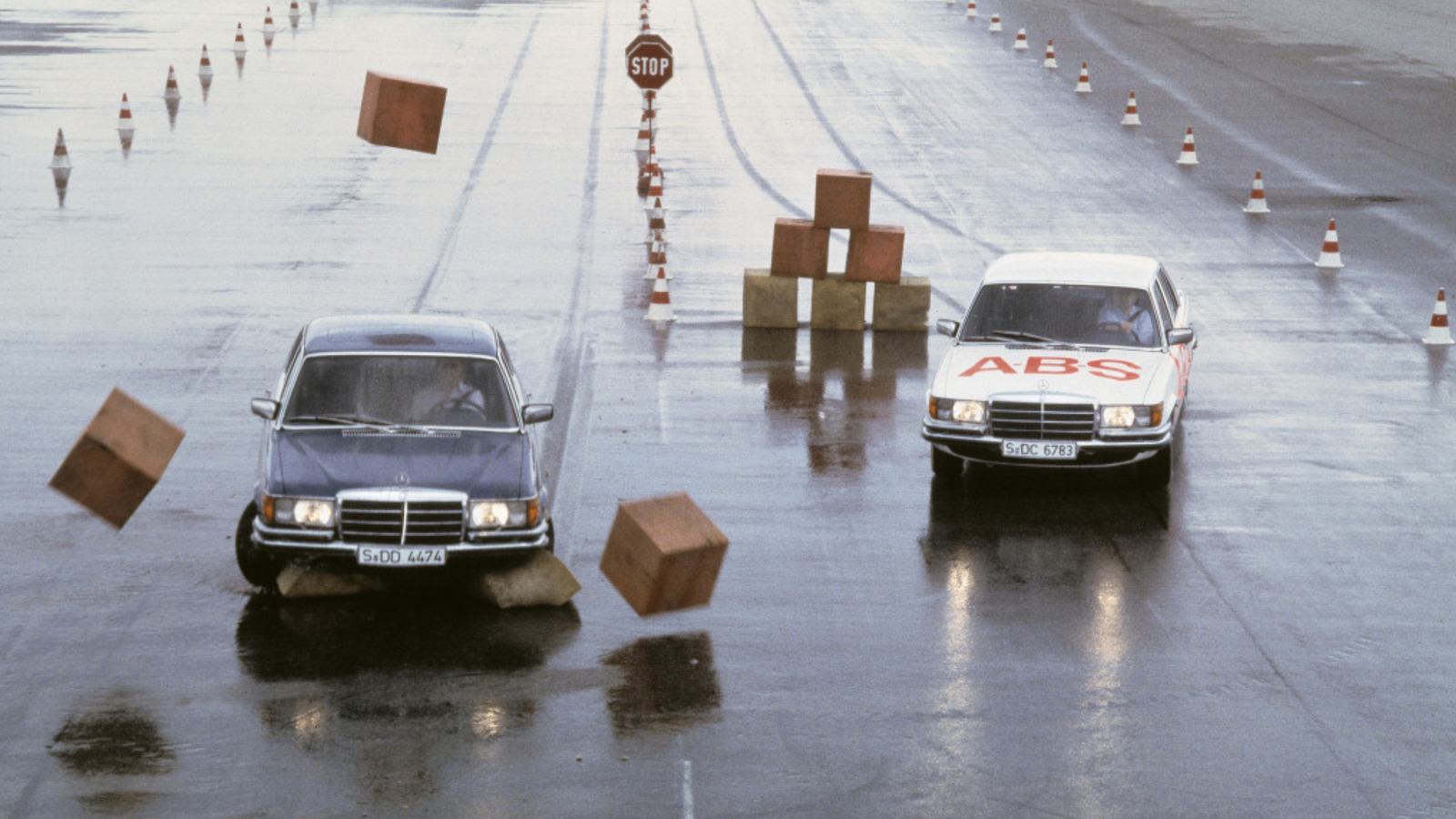
By the 1960s, German engineers finally cracked the code for production vehicles. Bosch developed a practical system, and select models began offering ABS as an option. Even then, uptake remained slow. Drivers didn't demand it. Mechanics didn't understand it. Insurance companies still didn't reward it. ABS remained a luxury curiosity through much of the 1970s and 1980s.
Federal mandates eventually forced the industry's hand. As crash test data mounted and liability exposure grew, regulators began requiring ABS on new vehicles. By the 1990s, ABS shifted from option to standard. Cost had also fallen dramatically as volume production ramped up.
Today, ABS is non-negotiable. Every production car sold in major markets includes it. The technology prevents wheel lockup during hard braking, maintains steering control, and reduces stopping distance on most surfaces. Real-world accident data confirms that ABS saves lives, particularly in emergency braking situations.
The irony remains stark. Aircraft solved this problem 20 years before cars. The technology didn't require aerospace materials or exotic engineering. Carmakers simply chose not to adopt it until economics and regulation forced their hand.
This pattern repeats across automotive safety. Airbags, stability control, automatic emergency braking, and collision avoidance systems all followed similar trajectories. Innovation exists in laboratories and aircraft before appearing in production vehicles. Cost, liability concerns, and competitive dynamics determine when and where new safety technology reaches drivers.
For consumers, the lesson cuts both ways. Aircraft accident rates plummeted with each new safety mandate. Car safety has improved measurably as well. Yet millions of drivers endured a decade or more of preventable crashes, injuries, and deaths while waiting for technology that already existed.